


Thinning hair can make choosing a haircut feel harder than it should be. You may wonder whether keeping a little hair with a buzz cut looks better or whether shaving everything creates a cleaner appearance.
There is no single answer for everyone. The better choice depends on how much density remains, where the thinning is happening, how strong the contrast is between your hair and scalp, and how comfortable you are with showing your head shape.
In general, a buzz cut works well when some remaining density still improves the overall shape. A shaved head can look better when thinning is advanced enough that the remaining hair creates obvious patches, recession, or uneven contrast.
The goal is not to hide hair loss at all costs. It is to choose the style that makes your appearance look intentional, balanced, and easy to maintain.
Quick answer: which is better for thinning hair?
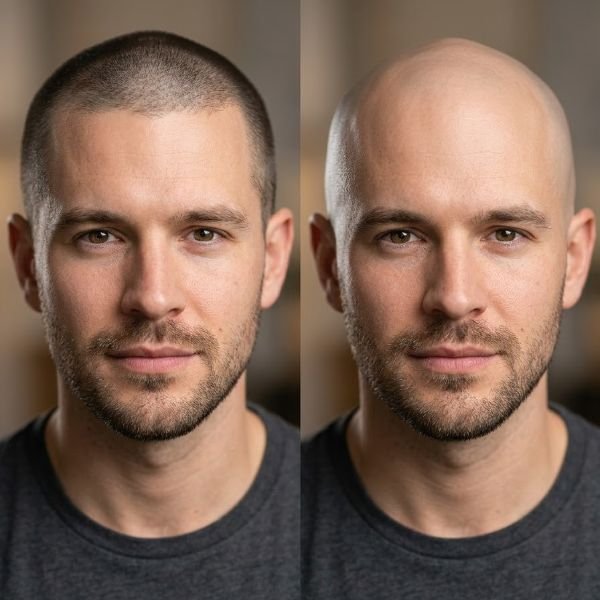
A buzz cut is usually better for early or moderate thinning, while a fully shaved head often looks better when thinning is advanced or uneven.
A #1 or #2 buzz can reduce the contrast between a receding hairline and the fuller areas around it. If the top still has reasonable density, keeping a small amount of hair can provide texture and definition.
Going bald can be the stronger choice when the scalp is already highly visible, the crown has large thin areas, or the sides look much denser than the top. Removing the remaining hair can make the difference between thick and thin areas less obvious.
A simple rule is:
Keep the hair if it still improves the shape. Remove it if it only highlights the thinning.
The main comparison: buzz cut vs bald
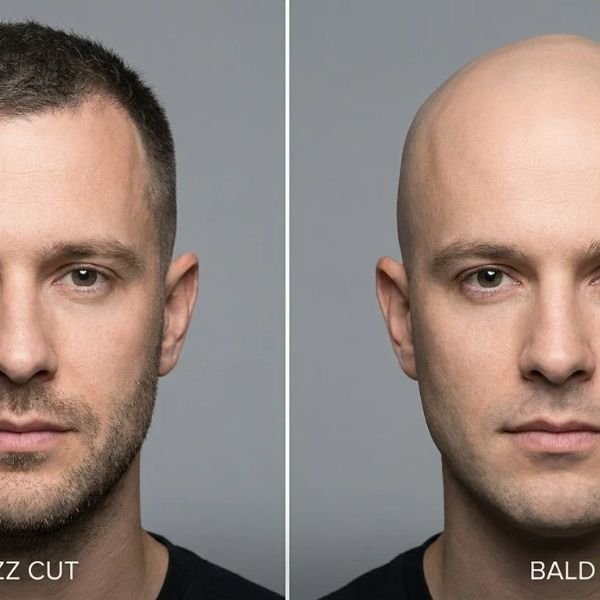
A buzz cut and a shaved head are not exactly the same look.
A buzz cut uses clippers to leave a short layer of hair. Depending on the guard, you may have anything from very short stubble to several millimeters of visible hair.
A bald or shaved style removes the hair much closer to the scalp. It creates a more uniform scalp appearance and eliminates most of the visual contrast caused by different hair densities.
| Feature | Buzz cut | Bald or shaved head |
| Hair remaining | Yes | Very little or none |
| Best for | Early to moderate thinning | Advanced or obvious thinning |
| Scalp visibility | Moderate to high | High |
| Maintenance | Frequent clipping | Frequent shaving |
| Styling flexibility | Some | Very little |
| Visual transition | Softer | More decisive |
| Works with beard | Yes | Yes |
| Main advantage | Keeps some hair while reducing contrast | Removes uneven density |
The most important factor is not simply how much hair you have. It is how the remaining hair interacts visually with the thinning areas.
No guard, electric shave, or wet shave?
These options sit on a spectrum.
A no-guard buzz leaves extremely short hair. It can be a useful middle ground if you want the appearance of a shaved head without using a razor.
An electric head shave gets closer to the scalp while usually being quicker and simpler than a traditional wet shave.
A wet shave creates the smoothest bald appearance. It also requires more attention to skin preparation, shaving technique, irritation, and maintenance.
If you are unsure, moving gradually is often smarter:
- Start with a #3 or #2.
- Assess the hairline and crown.
- Move to a #1 if the shorter length looks better.
- Try a no-guard or electric shave.
- Decide whether a completely smooth shave actually improves the look.
You can always remove more hair. You cannot immediately put it back.
Do not judge the options by identity alone
A buzz cut is not automatically more masculine, younger, or more attractive than a shaved head. Likewise, being bald does not automatically make someone look older or harsher.
The visual result depends on the individual.
Consider:
- Face shape
- Head shape
- Hairline pattern
- Crown density
- Skin tone and scalp contrast
- Beard growth
- Eyebrow density
- Personal grooming style
- Comfort with visible scalp
The best choice is the one that makes your overall appearance look balanced.
When a buzz cut usually looks better
A buzz cut often wins when thinning is noticeable but there is still enough hair to create an even short texture.
This is especially useful when the hairline is receding but the crown and top still have reasonable coverage. Shortening the hair reduces the difference between longer areas and thinner areas.
Instead of having several inches of dense hair next to a visibly receding hairline, you create a much more consistent visual field.
A #2 buzz is often a useful starting point because it leaves enough hair to retain texture without creating too much length in sparse areas.
A #1 can work when recession is more obvious. It gives the haircut a sharper, more deliberate appearance.
Why buzzed can beat bald in early-stage thinning
Early thinning does not always need a completely shaved solution.
If you still have decent coverage, shaving everything can expose the scalp more than you prefer. A short buzz gives you some texture while keeping the hairstyle extremely simple.
It can also make a receding hairline look intentional rather than something you are trying to conceal. Current barber guidance commonly recommends short, uniform cuts because they reduce the contrast between the hairline and the rest of the scalp.
A buzz can be especially effective when:
- Your crown is still relatively dense.
- Your recession is mild or moderate.
- You want to keep some visible hair.
- Your scalp is sensitive to shaving.
- You like the traditional buzz-cut appearance.
- Your head shape looks better with a small amount of hair.
One important point is that shorter does not always mean better. If you go too short too quickly, scalp visibility can increase. The right length is the one that produces the most even visual result.
When bald usually looks better
A shaved head can become the stronger option when your remaining hair creates more visual problems than benefits.
This can happen with significant crown thinning, extensive recession, diffuse thinning, or large areas where the scalp is already clearly visible.
If your sides are thick but your top is very sparse, even a short buzz may leave a noticeable difference. A clean shave removes much of that contrast.
The result can look more intentional because there is no attempt to make the remaining hair appear fuller than it is.
Why shaved can beat buzzed on obvious thinning
A buzz cut still leaves hair behind. That means differences in density can remain visible.
Suppose the sides have strong coverage but the crown is extremely thin. With a #2 buzz, the sides may still appear darker than the crown. That contrast can make the thinning easier to notice.
A shaved head changes the equation.
Instead of asking the viewer to compare different hair densities, the overall look becomes centered on the scalp, face, beard, and head shape.
This is why a shaved head can sometimes look cleaner than a buzz cut for advanced hair loss.
Shaving also does not make hair grow back thicker or denser. It only cuts the visible hair shaft and does not change the hair follicle underneath the scalp.
Which option works best for each thinning pattern?
Different thinning patterns can produce very different results.
| Thinning pattern | Good starting choice | Why |
| Mild temple recession | #2 to #3 buzz | Keeps texture while reducing contrast |
| Moderate receding hairline | #1 to #2 buzz | Makes the recession less visually dominant |
| Thin crown with good sides | #1 buzz or shave | Shorter hair reduces patchy contrast |
| Diffuse thinning | #1 or no-guard buzz | Creates a more uniform appearance |
| Large bald crown | No-guard or shaved | Remaining hair may emphasize the contrast |
| Advanced frontal loss | Shaved or very short buzz | Creates a deliberate, uniform look |
| Patchy thinning | Very short buzz or shave | Avoids longer strands separating around gaps |
These are starting points, not strict rules. Hair density can vary greatly from one person to another.
For example, a man with mild recession and a dense crown may look excellent with a #3. Another man with similar recession but significant crown thinning may look better at #1 or fully shaved.
The pattern matters more than the number on the clipper.
Maintenance: practical difference between buzzed and bald
Both styles are low maintenance compared with longer hairstyles, but neither is completely maintenance-free.
A buzz cut generally requires clipping every week or two if you want the length to stay sharp. Faster-growing hair may need attention sooner.
A shaved head requires regular shaving if you want completely smooth skin. Some people shave every few days, while others prefer light stubble.
With either option, basic scalp care matters.
Keep your scalp clean, moisturize when needed, and protect exposed skin from excessive sun. A shaved scalp can also make dryness, irritation, scars, moles, and other skin features more noticeable.
The practical difference is simple:
Buzzed means trimming. Bald means removing the hair repeatedly.
If you dislike shaving, a very short buzz may give you almost the same visual benefit with less skin-level maintenance.
Confidence: softer transition or cleaner decision?
Hair loss is not only a grooming decision. It can also be an emotional one.
Some men feel more confident after keeping a little hair. The buzz provides a gradual transition and may feel less dramatic.
Others feel better after shaving completely. The decision can remove the daily concern about whether the crown, hairline, or thinning areas are noticeable.
Neither reaction is wrong.
A useful question is:
When you look in the mirror, are you happier seeing a little hair or seeing a completely intentional shaved look?
If the buzz makes you constantly inspect the hairline, try going shorter.
If shaving makes you feel like you lost part of your personal style, keep a short buzz.
The best haircut is often the one you stop thinking about after you leave the mirror.
Best way to decide without regretting it
You do not have to make the decision all at once.
Use a gradual testing method.
1. Take a clear photo
Take front, side, and top photos in natural light. Avoid using only flattering angles.
2. Start longer
Try a #3 or #2 buzz first. This gives you room to evaluate your proportions.
3. Check the crown
Look at the top under normal lighting. Ask whether the remaining length improves the appearance or makes the thin area stand out.
4. Go shorter if needed
Move from #2 to #1 if the shorter cut looks more even.
5. Test the no-guard look
A no-guard clipper cut can show whether you prefer an almost shaved appearance.
6. Consider your beard
A beard can add definition around the lower half of the face and create balance with a very short haircut or shaved scalp.
7. Think about scalp comfort
If your scalp is easily irritated, a very close razor shave may not be your ideal everyday style.
8. Ask a skilled barber
A barber can assess the hairline, crown, density, and head shape from several angles. Ask them to remove length gradually rather than immediately taking everything off.
This approach reduces the risk of making a decision you dislike.
Final answer: choose the option that removes the most visual conflict
So, buzz cut vs bald for thinning hair is not really about which hairstyle is universally better.
A buzz cut is usually the better choice when you still have useful density and want to reduce the appearance of recession or thinning without fully exposing the scalp.
A shaved head is often better when the remaining hair creates strong differences between dense and sparse areas. Removing that contrast can make the entire appearance look cleaner and more intentional.
If you are undecided, start with a #2 buzz. It gives you a useful middle ground. If it looks better shorter, move toward a #1 or no-guard cut. If the scalp looks more balanced after removing the remaining hair, shaving may be the better final choice.
The simplest rule is this:
Choose the style that removes the most visual conflict, not necessarily the most hair.
Frequently Asked Questions
Is a buzz cut or shaved head better for thinning hair?
A buzz cut usually suits early or moderate thinning, while a shaved head can look cleaner when hair loss is advanced or highly uneven.
Does a buzz cut make thinning hair look thicker?
No. A buzz cut cannot increase hair density, but a short, uniform length can reduce contrast and make thinning appear less noticeable.
Should I buzz my hair before shaving it bald?
Yes, buzzing first is a practical way to test a shorter look before committing to a completely shaved scalp.
Who usually looks better fully bald than buzzed?
Men with advanced recession, significant crown loss, diffuse thinning, or strong differences between dense sides and a sparse top may prefer the cleaner appearance of a shaved head.
What buzz cut length is best for thinning hair?
A #1 or #2 is often a useful starting range, while #3 can work when density remains fairly strong. The ideal length depends on your specific thinning pattern.
Does shaving your head make hair grow back thicker?
No. Shaving cuts hair at the surface and does not change the follicle, hair density, or natural growth cycle.
How often should I maintain a buzz cut or shaved head?
A buzz cut may need trimming about every one to two weeks, while a smooth shaved head may require shaving every few days depending on your preferred level of stubble.

Noah is a passionate fashion writer who enjoys exploring the latest fashion trends, outfit ideas, styling tips, hairstyles, and seasonal looks. With a strong interest in modern style, Noah creates simple and helpful content to inspire readers and make fashion easier to explore. His goal is to share fresh ideas that help everyone feel confident in their personal style.
