


A thin hair buzz cut can make hair loss look cleaner, more balanced, and easier to manage. However, it does not work equally well for everyone. The right result depends on where your hair is thinning, how much density remains, your natural hair color, and the contrast between your hair and scalp.
For some men, a short buzz cut makes a receding hairline less noticeable. For others, especially those with advanced crown thinning or diffuse hair loss, cutting the hair very short can reveal more scalp than expected.
The goal is not to make thinning hair magically thicker. It is to choose a haircut that works with your current hair density instead of fighting against it. This guide explains when a buzz cut helps, which guard lengths to consider, when shaving your head may be a better option, and how to test the look before committing.
Quick answer: when a buzz cut helps and when it doesn’t
A buzz cut usually helps thinning hair when the remaining hair has reasonably even coverage and longer strands make sparse areas more noticeable. Keeping the hair short reduces the difference between thick and thin sections, creating a more consistent appearance.
It is particularly useful for mild recession, early crown thinning, and hair that looks uneven when styled. A short cut also requires less daily styling and eliminates the need to arrange longer strands over thinning areas.
However, a buzz cut is not always the best solution. If the scalp is already highly visible across the top, removing more length may expose the thinning pattern rather than soften it.
| Hair loss pattern | Is a buzz cut a good choice? | Suggested starting point |
| Mild temple recession | Often yes | #2 or #3 guard |
| Receding hairline with good top density | Usually yes | #2 to #4 guard |
| Mild crown thinning | Often yes | #2 or #3 guard |
| Noticeable crown bald spot | Depends on contrast | Test #1 or #2 |
| Diffuse thinning across the top | Depends on overall coverage | #1 to #3 guard |
| Advanced hair loss | A shaved head may suit you better | Compare a close buzz with a shave |
These guard lengths are starting points, not strict rules. Hair texture, scalp color, head shape, and personal preference can change the result.
A buzz cut is a contrast tool, not a camouflage trick
A buzz cut works by changing how the hair and scalp look together. It does not create new hair follicles or increase the actual number of hairs growing on your head.
When longer hair becomes thin, individual strands may separate and expose patches of scalp. Shorter hair stands closer to the scalp and creates a more uniform outline. This can make some forms of hair loss less distracting.
However, if very little hair remains in a particular area, shortening the surrounding hair cannot restore coverage. In that situation, a close buzz may make the entire appearance more intentional, but it will not hide the bald area.
Why buzzing can improve hair loss in the first place
Longer hair can create a misleading impression of uneven density. The front might look full while the crown separates into visible gaps. Styling products, bright overhead lights, and humidity can make this contrast even more obvious.
A buzz cut removes much of that styling problem. The hair has less length to separate, flatten, or fall across the scalp. The result is often simpler and more consistent throughout the day.
There are several practical benefits:
- Less contrast: Shorter hair can reduce the visual difference between dense and sparse areas.
- Simpler styling: You do not need to create a comb-over or repeatedly arrange strands.
- Cleaner shape: An even cut can make recession look like part of a deliberate hairstyle.
- Lower maintenance: Washing, drying, and styling generally take less time.
- More predictable appearance: Wind and humidity have less effect on a very short haircut.
It is important to understand one common misconception. Cutting hair does not make it grow back thicker, faster, or darker. Hair may feel coarser after cutting because the ends are blunt, but the follicles have not changed.
If your hair loss is progressing, a haircut can improve its appearance without treating the underlying cause. A dermatologist can help identify whether the problem is hereditary pattern hair loss, another medical condition, or a temporary shedding issue.
When a buzz cut helps recession
A receding hairline often begins at the temples. The front corners move backward while the hair behind them may remain relatively dense.
This pattern can make longer hairstyles difficult to manage. A side part, high quiff, or swept-back style may emphasize the difference between the hairline and the fuller top.
A buzz cut can reduce that contrast by bringing the hairline and the rest of the head closer to the same visual length. Instead of trying to cover the temples, you create a clean, intentional style.
For mild recession, a #2 or #3 guard is a sensible place to start. If the hairline is still strong and you want to retain more texture, a #3 or #4 may look more balanced.
Consider these options:
- Mild recession: Try a #3 guard for a short but relatively soft finish.
- Moderate temple recession: Consider a #2 guard to reduce the difference between the hairline and the top.
- Advanced recession with good side density: Compare a uniform buzz with a short crew cut or a shaved head.
- Recession with a thin crown: Ask your barber to evaluate the front and crown together before choosing the length.
A low taper can complement a buzz cut without creating too much contrast. Be cautious with a very high skin fade if the top is noticeably thin. Extremely short sides can make the remaining hair look less dense by comparison.
When a buzz cut helps crown thinning
The crown is the area around the natural hair whorl at the back of the top of the head. Hair grows in different directions here, so even normal growth patterns can expose small areas of scalp.
When crown thinning develops, longer hair may split around the whorl. This can create a visible bald spot, especially under bright lights or when the hair is wet.
A buzz cut can help by reducing the length that separates around the crown. If enough hair remains, an even short cut may blend the thinning area with the surrounding hair.
The best length depends on how visible the scalp is before cutting. Mild crown thinning may look better with a #2 or #3 guard, while a more noticeable bald spot may require comparing a #1 guard with a clean shave.
Avoid assuming that the shortest possible cut is automatically best. Very short hair can reveal the shape and size of a crown bald spot more clearly.
Before making a decision, check your crown in natural daylight and ordinary indoor lighting. A photo taken from above can also help you compare the crown with the front and sides.
If the crown is thinning rapidly, develops distinct patches, or becomes itchy, painful, or inflamed, consult a healthcare professional rather than relying on a haircut alone.
When a buzz cut helps diffuse thinning
Diffuse thinning means hair density decreases across a broad area rather than only at the temples or crown. The top may look less full overall, and the scalp may become visible through the hair.
A buzz cut can work well when the remaining hair has reasonably consistent coverage. Shortening the strands may reduce the appearance of separated sections and eliminate the need for heavy styling products.
However, diffuse thinning is one of the situations where results can be difficult to predict. If the hair is very fine and sparse throughout the top, a short cut may expose more scalp than a slightly longer textured hairstyle.
Consider a #2 or #3 guard first if you still have reasonable coverage. If the hair is extremely thin, compare a #1 guard with a slightly longer cut before deciding whether to go shorter.
A short textured crop is another option. It retains some length while allowing the hair to sit naturally without forcing thin strands into a particular direction.
Diffuse shedding can have several causes, including illness, stress, nutritional problems, medication effects, and hereditary hair loss. If the thinning is sudden or widespread, seek medical advice to identify the cause.
The guard lengths that usually work best
Clipper guard numbers indicate how much hair remains after cutting. On many standard clipper sets, each guard corresponds to a particular length, although measurements can vary by brand.
| Guard | Approximate hair length | Best use |
| #1 | 3 mm or 1/8 inch | Very short buzz with visible scalp |
| #2 | 6 mm or 1/4 inch | Balanced starting point for many thinning patterns |
| #3 | 10 mm or 3/8 inch | Retains more texture and softness |
| #4 | 13 mm or 1/2 inch | More coverage when the top still has density |
| No guard | Depends on clipper blade | Extremely close cut, often approaching stubble |
For many men with thinning hair, a #2 or #3 guard is a practical starting point. These lengths are short enough to simplify the hairstyle while leaving some hair above the scalp.
A #1 guard can work when you prefer a very short, uniform appearance. However, it can make scalp visibility more obvious, particularly when hair and skin colors contrast strongly.
A #4 guard may be better when you have mild thinning and want to preserve more coverage. The downside is that longer strands may still separate and reveal sparse sections.
Use this simple decision process:
- Start with a longer guard than you think you need.
- Check the result in natural light and from different angles.
- Compare the front, crown, and sides.
- Move one guard shorter only if the result improves.
- Ask your barber to keep the top and sides balanced rather than automatically choosing a high fade.
Remember that guard numbers are not universal measures of how much hair you will see. Your hair color, thickness, curl pattern, and scalp pigmentation all influence the final appearance.
When a buzz cut doesn’t help anymore
A buzz cut becomes less effective as a camouflage strategy when the scalp is already clearly visible across most of the top. At that stage, removing more length may not create the even coverage you want.
This does not mean a buzz cut is a bad hairstyle. It simply means you should judge it as a style rather than a way to conceal hair loss.
A buzz cut may not give you the desired result when:
- The crown has a large, clearly defined bald spot.
- The top is substantially thinner than the sides.
- Diffuse thinning leaves very little coverage.
- A very short guard makes scalp contrast more noticeable.
- You prefer the softness and texture of a slightly longer haircut.
- Close clipping causes irritation or aggravates an existing scalp condition.
You should also consider your head shape and natural hairline. A short haircut exposes more of the head’s outline, including bumps, scars, and uneven areas that longer hair may soften.
If you dislike the result, you have alternatives. A short crew cut, textured crop, or carefully balanced scissor cut may preserve more coverage. You can also choose a shaved head if you prefer a consistent scalp-level appearance.
Buzz cut vs shaved head for hair loss
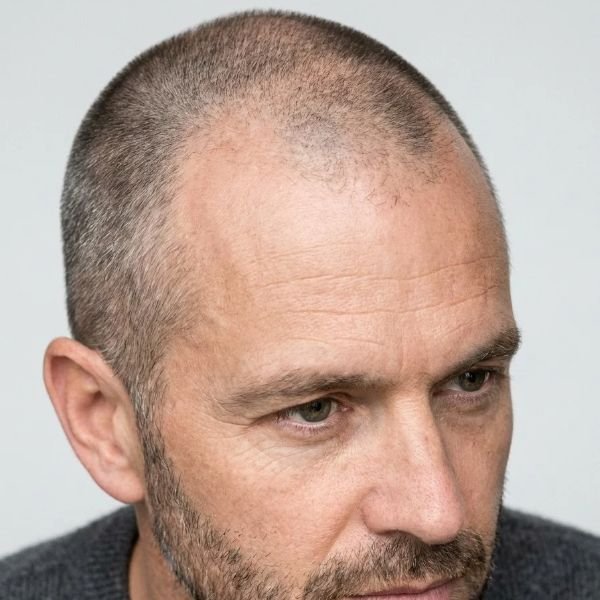
A buzz cut leaves a small amount of hair, while a shaved head removes most or all visible hair above the skin. Both can be effective styles, but they create different visual effects.
A buzz cut is usually easier to test because you can gradually reduce the length. It may also retain enough texture to soften scalp contrast.
A shaved head creates a more uniform appearance when hair loss is advanced. However, it exposes the scalp fully and requires attention to sun protection, skin irritation, and shaving technique.
| Feature | Buzz cut | Shaved head |
| Hair remaining | Short stubble or visible hair | Little to no visible hair |
| Scalp coverage | Depends on guard and density | Scalp is fully exposed |
| Maintenance | Regular clipper trims | Frequent shaving or close trimming |
| Best suited to | Mild to moderate thinning, depending on coverage | People who prefer a fully shaved look |
| Main drawback | Sparse areas may remain visible | Scalp irritation and sun exposure |
Neither choice is universally better. If your thinning is moderate, a buzz cut may provide the right balance. If the top is almost completely bald, shaving may create a cleaner overall appearance.
How to test the decision without regret
You do not need to jump straight from longer hair to a very short buzz. A gradual approach lets you evaluate the result before removing more length.
Follow these steps:
- Take baseline photos. Photograph the front, both temples, crown, and sides before cutting. Use ordinary lighting rather than relying on a single flattering angle.
- Start with a #4 guard. This gives you a short haircut while retaining some visible length.
- Evaluate the shape. Check whether the hairline and crown look more balanced. Notice whether the scalp stands out more or less.
- Move to a #3 or #2 if needed. Ask your barber to shorten the hair gradually and compare the result.
- Live with the haircut. Give yourself time to see how it looks during normal activities, in daylight, and after washing.
- Compare alternatives. If shorter lengths make the scalp more noticeable, consider a textured crop or a shaved head instead.
Before visiting a barber, explain that your goal is to make thinning hair look balanced. Ask for a conservative guard length and a natural hairline. You can also request a low taper instead of a dramatic skin fade.
If you are uncertain, avoid making the first cut immediately before an important event. A little time to adjust can help you decide whether the style suits your preferences.
Final answer: should you get a buzz cut for hair loss?
A buzz cut is worth considering if your hair is thinning, longer styles are becoming difficult to manage, and you want a low-maintenance appearance. It often works particularly well for mild recession and early crown thinning because it reduces the contrast between longer strands and sparse areas.
Start with a #2 or #3 guard if you have moderate coverage, or a #3 or #4 if you want to preserve more length. If your scalp is already highly visible, test different lengths before deciding whether a close buzz or shaved head suits you better.
Most importantly, choose the cut based on your actual hair pattern rather than assuming shorter is always better. A good haircut should make you feel comfortable and confident, not force you into a style you do not enjoy.
A buzz cut can change how hair loss looks, but it cannot stop the underlying process. If thinning is new, sudden, or progressing quickly, consult a dermatologist about possible causes and appropriate treatment options.
Frequently Asked Questions
Is a buzz cut good for thinning hair?
Yes, a buzz cut can make thinning hair look more even by reducing the contrast between dense and sparse areas. Results depend on the amount of remaining hair and where the thinning occurs.
Can a buzz cut make thinning hair look worse?
Yes, especially when the scalp is already visible across the crown or top. Cutting the hair too short can expose sparse areas instead of blending them.
What buzz cut length is best for thinning hair?
A #2 or #3 guard is a useful starting point for many men. A #4 may preserve more coverage, while a #1 creates a much shorter appearance with potentially greater scalp visibility.
Should I buzz my hair or shave it bald?
Choose a buzz cut if you want to retain some hair and test different lengths. Consider shaving if you prefer a completely uniform scalp-level appearance and have extensive hair loss.
How can I test a buzz cut before cutting my hair?
Start with a #4 guard and assess the result in natural light. If you like the appearance, gradually move shorter to a #3 or #2 instead of removing too much hair at once.

Noah is a passionate fashion writer who enjoys exploring the latest fashion trends, outfit ideas, styling tips, hairstyles, and seasonal looks. With a strong interest in modern style, Noah creates simple and helpful content to inspire readers and make fashion easier to explore. His goal is to share fresh ideas that help everyone feel confident in their personal style.
