


Hair loss changes more than the hairline. It changes how a haircut behaves.
A style that looked thick and sharp two years ago can suddenly expose the temples, crown, or scalp. That does not mean you need to grow your hair longer. In many cases, the better move is to make the haircut simpler.
The best hairstyles for balding men depend on where the hair is thinning, how much density remains, and how strongly the haircut contrasts with the scalp. A textured crop can work beautifully during early recession. A short crew cut may make more sense when the crown starts opening. A buzz cut or shaved head can become the cleanest choice when the top is significantly thinner.
The Norwood scale is useful for understanding the general progression of male pattern hair loss, but it is not a substitute for a professional diagnosis. Two men at the same stage can have very different density, hair texture, face shape, and rate of loss.
Quick answer: what styles usually work?
The best haircut is usually the one that makes thinning look intentional rather than hidden.
| Hair-loss pattern | Styles worth considering | Main goal |
| Early recession | Textured crop, Ivy League, short quiff | Preserve shape |
| Norwood 2 | Side part, crew cut, textured crop | Keep natural density |
| Norwood 3 | French crop, Caesar, crew cut, short buzz | Reduce visual contrast |
| Crown thinning | Short textured crop, crew cut, buzz | Stop scalp separation |
| Diffuse thinning | Short crop, crew cut, buzz | Make density look consistent |
| Advanced loss | Buzz cut, close shave, shaved head | Create a deliberate silhouette |
Current haircut guides consistently favor shorter, controlled styles as recession and thinning become more visible. Textured crops, crew cuts and buzz cuts appear repeatedly because they reduce the need to manipulate sparse hair into artificial coverage.
The important point is that shorter does not automatically mean better. Going too short too early can expose scalp that was previously easy to disguise. The right length depends on density, not just the hairline.
Cleaner beats fuller once the hair stops cooperating
There is a point where extra length stops creating fullness.
Longer hair can separate around a thinning crown. It can fall apart in wind. It can create visible gaps around the temples. Shiny products can make individual strands clump together and expose more scalp.
A cleaner haircut removes some of those problems.
Instead of asking, “How can I make my hair look like it used to?” ask, “What haircut looks strongest with the hair I have now?”
That small change in thinking makes choosing a hairstyle much easier.
Best hairstyles for balding men by stage
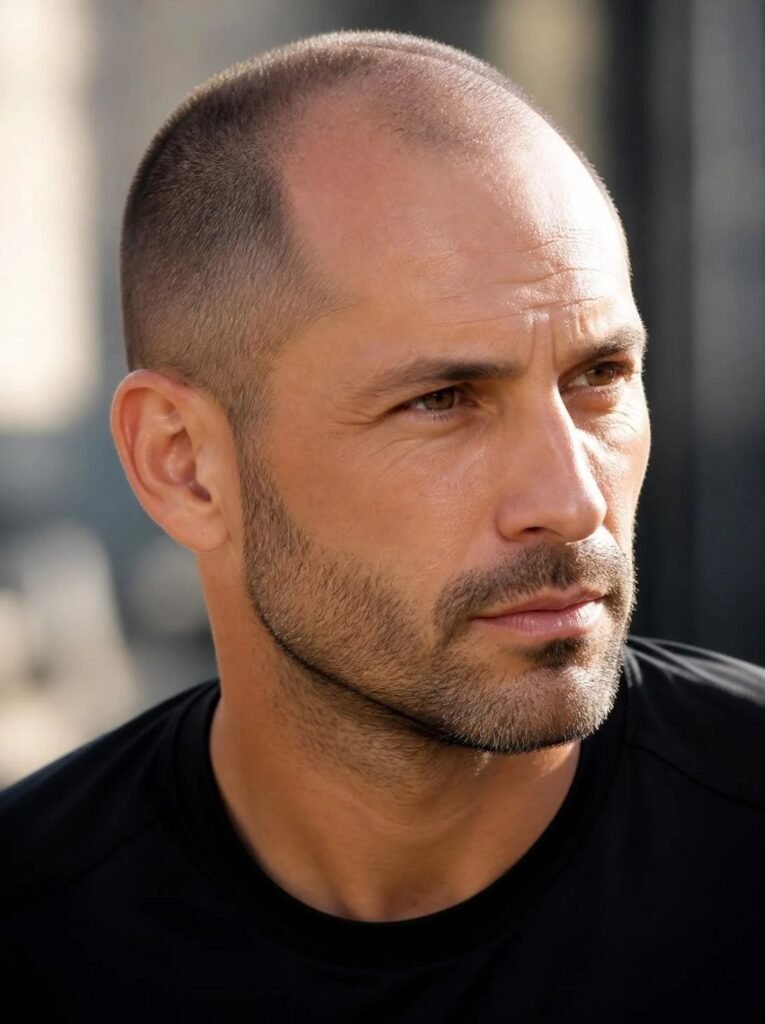
Hair loss does not progress in exactly the same way for every man. Some men lose their temples first. Others notice the crown. Some experience diffuse thinning across the entire top.
That is why the haircut should follow the pattern, not just the number on a Norwood chart.
Early recession: keep shape, lose the denial
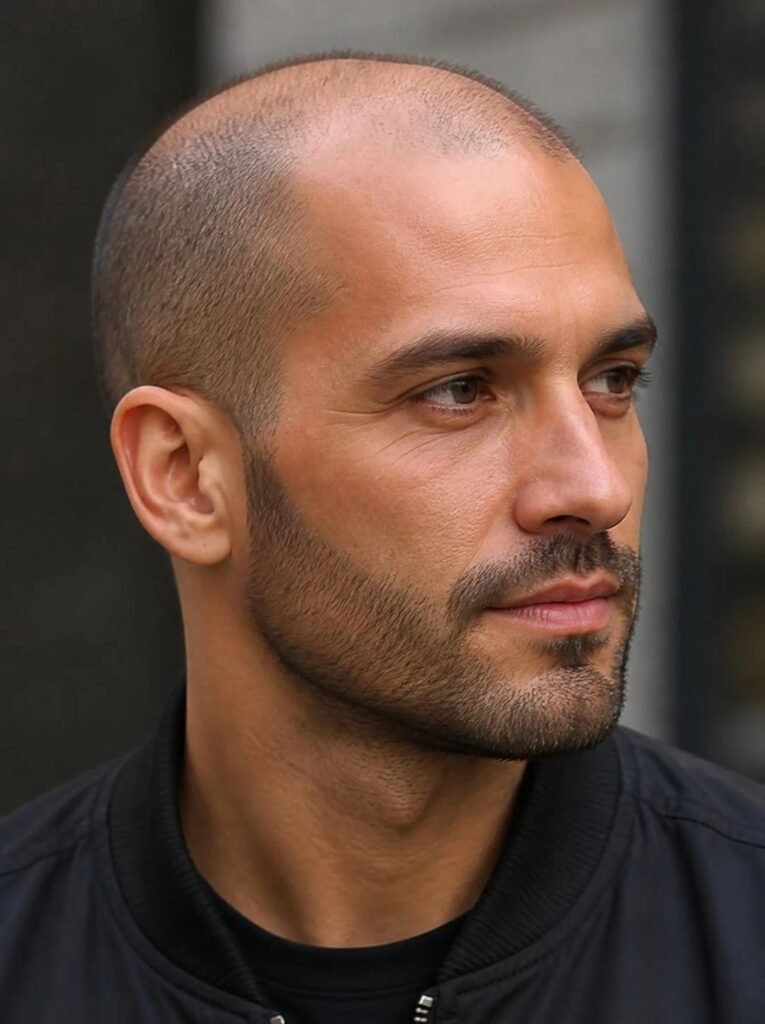
Early recession often means the temples have moved back slightly while the center of the hairline and top remain relatively strong.
This is not the time to panic and automatically shave everything.
You can still use moderate length if the hair has good density.
Good options include:
- Textured crop
- Ivy League
- Short crew cut
- Short quiff
- Natural side part
- Textured brush-up
The goal is controlled movement rather than maximum height.
A matte clay or lightweight styling cream can add separation without making the hair look greasy. Avoid creating a large, rigid front that draws attention directly to the temples.
If your center hairline remains dense, a short quiff can still work. If the temples are becoming more noticeable, a forward textured crop can soften the transition.
At this stage, the haircut should work with the hairline instead of trying to redraw it.
Norwood 2: do not shave too early
Norwood 2 generally describes mild temple recession. The hairline can have a more mature shape while the overall top remains reasonably dense. The Hamilton-Norwood system identifies this as slight recession around the temples.
You still have plenty of styling flexibility.
Consider:
- Side part with natural texture
- Ivy League
- Textured crop
- Crew cut
- Short quiff
- Short brushed-back style
The biggest mistake here is assuming that any recession requires a buzz cut.
It does not.
If your density is good, keeping some length can actually give you more control. The key is avoiding exaggerated volume or a hairstyle that depends on pushing a large amount of hair over the temples.
A barber can also taper the sides while keeping enough length on top to preserve proportion.
The objective is simple: make the haircut look deliberate without making the hairline the center of attention.
Norwood 3: this is where shorter starts winning
Norwood 3 usually means the temple recession is substantially deeper. The characteristic M-shaped hairline becomes easier to see.
This is often the stage where men discover that their old hairstyle no longer behaves the same way.
Longer front sections can become difficult to control. The hair may separate at the corners instead of covering them.
Shorter styles become more useful.
Strong options include:
- Textured crop
- French crop
- Caesar cut
- Crew cut
- Short buzz cut
- Short textured top with a taper
A forward crop works because texture breaks up the straight visual line around the front.
A crew cut works differently. It keeps the haircut structured without requiring the front hairline to create all the coverage.
A buzz cut is another option, particularly if the density across the top is still relatively even.
At this stage, uniformity often matters more than volume.
Crown thinning: reduce separation before you do anything dramatic
Crown thinning can be surprisingly difficult to style.
The problem is not always a completely bald spot. It may simply be that the natural hair whorl is becoming more visible.
Long hair can make this worse.
As strands separate around the crown, scalp becomes visible through the gaps. Trying to grow the crown longer can therefore create the opposite of the intended effect.
Better choices include:
- Short crew cut
- Textured crop
- Short buzz cut
- Short taper with controlled top length
- Caesar-style crop
Keep the crown short enough that it does not form large separated sections.
Matte products can also help because they provide texture without the wet, clumped appearance created by high-shine gels.
Current barber guidance similarly recommends keeping the crown controlled rather than growing extra length to cover an opening area.
If crown thinning is progressing quickly, however, do not assume it is simply a haircut issue. A dermatologist can help determine whether you are experiencing androgenetic alopecia or another cause of hair loss.
Diffuse thinning: texture stops helping fast
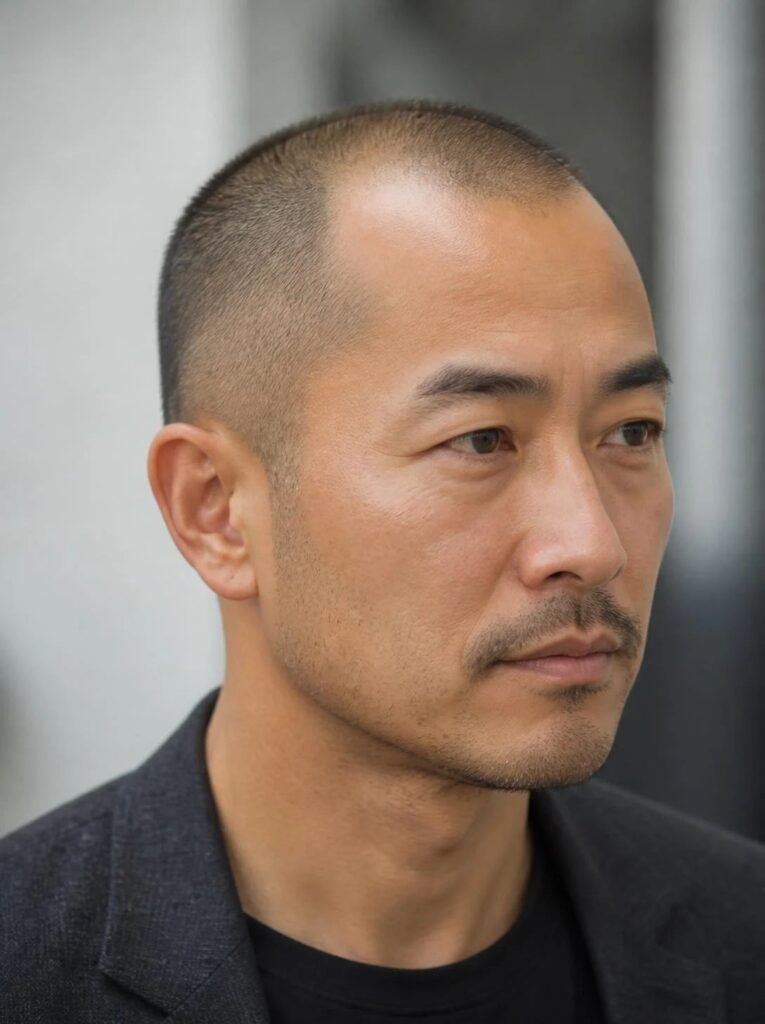
Diffuse thinning is different from simple temple recession.
Instead of one obvious area becoming thinner, density decreases across a larger portion of the scalp.
This changes the haircut strategy.
A heavily textured style can sometimes make diffuse thinning look worse because individual pieces separate. Large amounts of styling product can also make strands clump.
Better options are usually:
- Short textured crop
- Crew cut
- Short buzz cut
- Uniform short haircut
- Close-cropped style with a clean taper
The aim is to reduce the difference between thicker and thinner zones.
If the hair looks significantly thinner whenever it gets longer, test a shorter cut. Do not automatically jump to the shortest possible guard. Move down gradually and compare the result.
A #3 may work. A #2 may look cleaner. In some cases, an even shorter cut works best.
The correct answer is the length that creates the most consistent visual density.
Advanced hair loss: the haircut should stop arguing with reality
Advanced hair loss often involves significant loss at both the front and crown. In later Norwood stages, the bridge of hair between those areas can become increasingly thin or disappear.
At this point, long hairstyles usually require too much maintenance for too little visual benefit.
Consider:
- Buzz cut
- Very short clipper cut
- High and tight
- Close shave
- Clean-shaven head
A shaved head is not a requirement.
Some men look better with a short buzz because it preserves a little scalp shadow and creates a softer transition. Others prefer shaving because it removes the remaining contrast between sparse top hair and stronger sides.
A beard can also create useful balance if you already wear one. It shifts some visual weight toward the lower face, although it is completely optional.
The strongest style is the one that looks intentional from every angle.
Styles balding men usually should avoid
There are no absolute haircut rules. Personal style and face shape still matter. However, several choices tend to become harder to manage as density decreases.
1. Extreme comb-overs
A comb-over can work as a normal hairstyle when the hair is naturally thick.
It becomes problematic when large sections are stretched across genuinely sparse areas. Wind and movement can quickly reveal the separation.
2. Very long hair over thin areas
Length does not equal density.
Long strands may cover an area while simultaneously making the surrounding scalp more visible.
3. High-shine products
Wet-look gels and glossy pomades can make strands stick together.
That can increase visible scalp.
A matte clay, paste, or light texturizer is often easier to control.
4. Excessive height
A large pompadour or tall quiff can exaggerate the difference between thick and thin sections.
If the front is receding, extreme height can also pull attention toward the hairline.
5. Hard parts through thinning areas
A hard part creates a deliberate scalp line.
If your hair is already thinning nearby, that additional separation may make the area look more exposed.
6. Keeping the sides too long
Long, heavy sides can make a thinning top appear even thinner by increasing the difference in density.
A controlled taper or fade can create better overall balance.
Buzz cut or shaved head?
Both can work. The choice depends mainly on remaining density and how much contrast you want.
A buzz cut is usually the better transition when you still have reasonable top coverage.
A shaved head can become more attractive when the top is significantly thinner than the sides and the remaining hair is no longer improving the overall shape.
| Consideration | Buzz cut | Shaved head |
| Remaining top density | Better with moderate density | Less important |
| Maintenance | Very low | Very low |
| Hairline visibility | Still visible | Less distracting |
| Transition from longer hair | Easier | More dramatic |
| Crown thinning | Can work well | Often simplifies it |
| Face/head shape | Still important | More exposed |
| Styling required | Almost none | None |
If you are uncertain, do not make the decision permanent in your head before testing it.
Try a shorter buzz first.
If that looks cleaner than your previous haircut, go shorter if you want. The decision becomes much less intimidating when you treat it as a progression rather than a single dramatic change.
Recent 2026 haircut guidance similarly identifies the buzz cut as a strong option for recession because it reduces the visual difference between the hairline, top and sides
Final answer: choose the haircut that removes the most visual conflict
The best hairstyles for balding men are not about pretending that hair loss is not happening.
They are about proportion.
Early recession can still support a textured crop, Ivy League, short quiff or crew cut. Norwood 2 usually gives you plenty of freedom. By Norwood 3, shorter styles often become easier to manage. Crown thinning generally benefits from controlled length that does not separate around the whorl. Diffuse thinning often looks more consistent when the overall haircut is shorter.
Advanced hair loss is where a buzz cut or shaved head can become especially effective.
The simplest rule is this:
Keep enough length to make the hair look intentional, but not so much length that the thinning areas become the main feature.
And remember that a haircut only changes appearance. If hair loss is new, rapid, patchy, or concerning, speak with a dermatologist. Treatment options depend on the underlying cause, and early evaluation can matter.
Frequently Asked Questions
What are the best hairstyles for balding men?
The best options include textured crops, crew cuts, short quiffs, buzz cuts and shaved heads, depending on the hair-loss pattern and remaining density.
Does the best haircut depend on the Norwood stage?
Yes. Early recession can support longer textured styles, while moderate or advanced loss often looks better with shorter, more uniform cuts.
Should balding men get a buzz cut or shave their head?
A buzz cut works well when the top still has useful density. A shaved head may look cleaner when the top is substantially thinner than the sides.
What hairstyles should balding men avoid?
Avoid styles that rely heavily on covering sparse areas, including extreme comb-overs, very long thin sections, excessive height and heavy shiny products.
Does shorter hair make thinning look better?
Often, yes. Shorter hair can reduce the visual contrast between dense and sparse areas, but the ideal length depends on your remaining density.
What is the best haircut for a receding hairline?
A textured crop, crew cut, short quiff or buzz cut can work well. The best choice depends on how deep the recession is and how dense the top remains.
Can a haircut stop male pattern baldness?
No. A haircut can improve the appearance of thinning hair, but it does not stop the biological process causing hair loss.

Noah is a passionate fashion writer who enjoys exploring the latest fashion trends, outfit ideas, styling tips, hairstyles, and seasonal looks. With a strong interest in modern style, Noah creates simple and helpful content to inspire readers and make fashion easier to explore. His goal is to share fresh ideas that help everyone feel confident in their personal style.
