


A thinning crown can be difficult to style because the hair loss is often most visible from above, in bright lighting, or in photos. A longer hairstyle may seem like it gives more coverage, but it can also make the crown look thinner by creating stronger contrast between dense and sparse areas.
A buzz cut for a balding crown takes a different approach. Instead of trying to hide the thinning area, it reduces the difference between the crown and the surrounding hair. The result can look cleaner, more deliberate, and easier to maintain.
The important question is not simply whether you should buzz your hair. It is which buzz cut length works best for your level of crown thinning. For many men, a #2 or #1 is a useful starting point, while a #0 or full shave can make more sense when the crown is already clearly bald.
Quick answer: A #2 buzz is often a good starting point for mild crown thinning. A #1 usually works better when the crown is clearly visible. If the crown remains noticeably bare at #1, compare a #0 with a fully shaved head.
Quick answer: what usually works best
There is no single buzz cut length that works for every balding crown. Hair density, scalp contrast, hair color, head shape, and the size of the thinning area all affect the result.
As a practical starting guide:
| Crown condition | Length to consider | Why |
| Very mild thinning | #3 | Keeps more texture while reducing excess length |
| Early visible thinning | #2 | Good balance of coverage and reduced contrast |
| Noticeable crown loss | #1 | Makes the top more uniform |
| Obvious bald spot | #0 or shaved | Removes the contrast created by surrounding hair |
A #2 is often the most comfortable first experiment. It is short enough to change the appearance of the crown without immediately committing to an extremely short style.
If the crown is already obvious in normal lighting, however, a #1 may give a cleaner result. When even a #1 leaves a distinct bald area surrounded by darker hair, going shorter can make the entire look more intentional.
The goal is not to choose the shortest possible haircut. The goal is to find the length where the crown attracts the least unwanted attention.
Crown thinning is mostly a contrast problem
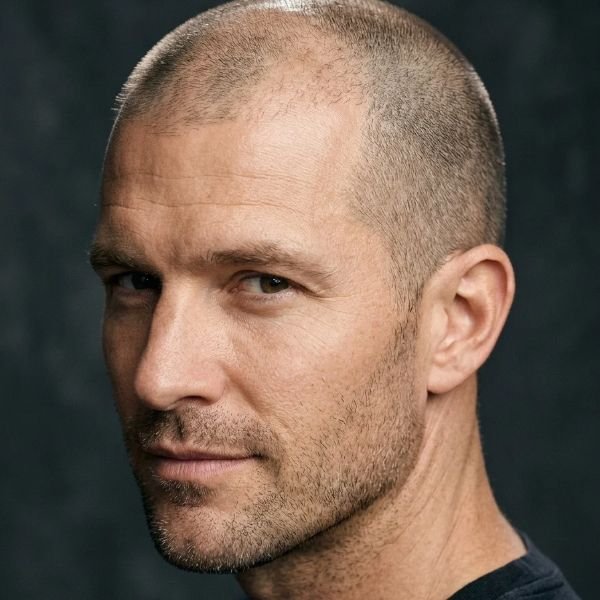
Crown thinning is not only about how much hair you have. It is also about how different the thin area looks from the hair around it.
Imagine a dark, dense ring of hair surrounding a lighter scalp area. Your eye naturally notices the lighter center. Longer hair can sometimes make this effect stronger because strands separate around the natural crown swirl.
A shorter buzz makes the surrounding hair less dominant. Instead of having dense sides and longer strands framing a sparse crown, you create a much more consistent texture.
This does not reverse hair loss. It simply changes the visual relationship between the remaining hair and the scalp.
Research-based medical sources also recognize the crown as a common area affected by male pattern hair loss. The American Academy of Dermatology and Cleveland Clinic describe crown or top-of-head thinning as a common pattern of hereditary hair loss. A haircut can change appearance, but it cannot treat the underlying cause.
Why the crown is harder to judge
The crown is one of the most difficult areas to evaluate yourself. You cannot normally see it directly in a mirror.
Lighting makes the problem even more confusing. Overhead bathroom lights shine directly onto the crown and can make scalp visibility look much worse. Wet hair can have the same effect because individual strands clump together.
Photos can also exaggerate or minimize thinning depending on the camera angle.
For a more realistic assessment:
- Take a photo from directly above.
- Take another photo from behind.
- Check your hair when it is dry.
- Use natural daylight rather than harsh overhead lighting.
- Compare several photos instead of judging one image.
- Ask a barber to assess the crown from the back.
The natural hair whorl should also be considered. Almost everyone has some scalp visibility around the crown because the hair grows in a circular pattern. A visible whorl does not automatically mean significant balding.
If the area is progressively becoming larger or the hair around it is becoming finer, that is more consistent with genuine thinning and is worth discussing with a dermatologist.
The best buzz cut lengths for a balding crown

Clipper guard numbers are useful because they give you a practical way to test different lengths. Exact measurements can vary slightly between clipper brands, but common lengths are approximately:
| Guard | Approximate length | Best use |
| #4 | 13 mm | Minimal thinning with strong density |
| #3 | 10 mm | Early thinning |
| #2 | 6 mm | Mild to moderate crown thinning |
| #1 | 3 mm | Noticeable crown thinning |
| #0 | Very short | Advanced thinning or transition to shaving |
#3 buzz cut
A #3 can work when the crown is only beginning to thin.
It leaves enough hair to retain texture and a softer appearance. It may also be more comfortable if you are nervous about exposing your scalp.
The downside is that #3 can leave enough length for the crown to separate around the whorl. If the bald spot is already obvious, this length may not solve the contrast problem.
#2 buzz cut
The #2 is one of the most useful starting points for a thinning crown.
At roughly 6 mm, the hair is short enough to reduce the difference between dense and thin areas. At the same time, it retains some visible hair coverage.
Consider a #2 if:
- Your crown is thinning but not completely bald.
- You still have reasonable density across the top.
- You want a short haircut without immediately going extremely short.
- Your current longer hairstyle makes the crown more obvious.
For many men, this is the first length worth testing.
#1 buzz cut
A #1 is a stronger option for a noticeably thinning crown.
At roughly 3 mm, there is very little length available for the hair to split around the crown. This can make the overall texture look more uniform.
The tradeoff is scalp visibility. If your hair is very dark and your scalp is significantly lighter, a #1 can make the scalp more visible. That does not necessarily mean it looks worse. It simply creates a more obvious short-hair appearance.
A #1 is particularly worth considering when a #2 still leaves the crown looking like a separate thin patch.
#0 buzz cut
A #0 is extremely short and sits close to the appearance of a shaved head.
It can work well when the crown is already clearly bald. At this point, retaining a little more hair may actually create more contrast between the remaining hair and the bald area.
The #0 also exposes more of your head shape, hairline, and scalp. That makes head shape and personal preference more important.
When a buzz cut helps, and when it stops helping
A buzz cut usually helps most when there is enough hair left to create a relatively even short texture.
It can be particularly effective when:
- The crown is mildly or moderately thin.
- The surrounding hair is substantially denser.
- Longer hair separates around the crown.
- You frequently adjust your hairstyle to hide the area.
- Styling products make the thin spot more visible.
- You want a low-maintenance haircut.
The situation changes when the crown becomes a clearly defined bald area.
At that point, shortening the hair may not make the area disappear. Instead, it changes the question from “How can I hide the crown?” to “Does a uniform short style look better than trying to preserve coverage?”
That is an important distinction.
A buzz cut should not be judged by whether it magically hides hair loss. Judge it by whether it makes your overall appearance more balanced.
When shaving fully starts to make more sense
A fully shaved head can make sense when the remaining hair creates more contrast than the bald area itself.
Consider comparing a shave with a buzz cut if:
- The crown is clearly bald.
- The thinning extends across much of the top.
- A #1 still leaves a strong horseshoe-like contrast.
- You are constantly trying to disguise the crown.
- You prefer an intentionally bald appearance.
- You like the simplicity of shaving.
Shaving is not automatically better than buzzing. Some men look better with a small amount of visible hair because it adds texture and definition.
Your face shape, head shape, beard, eyebrows, and overall personal style also influence the result.
One useful approach is to move gradually. Try #2 first, then #1, then #0 if necessary. You can then decide whether shaving completely improves the balance.
How to make the decision without regretting it
Do not make the decision based on one bad bathroom mirror moment.
Use a controlled test instead.
1. Photograph your current hair
Take clear photos from the front, sides, and top. Keep the lighting consistent.
2. Start with a #2
If your thinning is mild, #2 provides a useful middle ground. It is short enough to reveal whether reducing contrast helps.
3. Compare the crown from behind
Ask someone to take a photo or use two mirrors. The crown needs to be judged from the same angles other people see.
4. Try #1 if needed
If #2 still leaves a distracting thin spot, go shorter. A #1 often provides a clearer answer.
5. Compare #1 with #0
Do not assume that stopping at #1 is the best option. If the #0 looks more balanced, you have useful evidence that going shorter may suit you.
6. Consider your scalp and head shape
Very short hair exposes more of both. Check for noticeable scalp pigmentation, scars, bumps, or other features before committing to a close shave.
7. Think about maintenance
A buzz cut is low styling but not necessarily zero maintenance. Very short hair loses its shape quickly, so many men need a trim every few weeks.
8. Do not ignore progressive hair loss
If you are experiencing rapid or unexplained hair loss, a dermatologist can help determine the cause. Male pattern hair loss is common, but not every type of hair loss has the same cause or treatment.
Final answer: what is the best buzz cut for a balding crown?
For most men with a balding crown, a #2 buzz cut is a sensible starting point, especially when the thinning is mild to moderate.
If the crown is clearly visible, a #1 buzz cut often creates a more uniform appearance by reducing the amount of hair that can separate around the crown.
If the crown remains strongly defined at #1, compare a #0 or fully shaved head. At that stage, keeping extra length may create more contrast rather than more coverage.
The simplest guide is:
- #3: early thinning
- #2: mild to moderate crown thinning
- #1: noticeable crown thinning
- #0: advanced thinning
- Shaved: when embracing the bald look creates the cleanest overall appearance
The best buzz cut is therefore not necessarily the shortest one. It is the length that makes your entire head look intentional and balanced, rather than making the crown the main feature.
Frequently Asked Questions
Is a buzz cut good for a balding crown?
Yes. A buzz cut can reduce the visual contrast between thinning crown hair and denser surrounding hair, making the overall haircut look more uniform.
What buzz cut length is best for a balding crown?
A #2 is a good starting point for mild thinning, while a #1 often works better when the crown is clearly visible.
Can a buzz cut make a bald spot on the crown look worse?
Yes, especially if the surrounding hair remains much darker or denser than the bald area; testing shorter lengths can reduce that contrast.
Should I buzz or shave if my crown is thinning?
Buzz first if you still have reasonable crown density; shaving becomes more appealing when the bald area is clearly defined and remains distracting at very short lengths.
Does a shorter buzz cut hide crown thinning better?
Often, yes. Short hair reduces the separation and parting that can make a thinning crown stand out, although very short hair also exposes more scalp.
Is a #2 or #1 better for a thinning crown?
A #2 offers more coverage and is a safer first test, while a #1 can look cleaner when the crown is noticeably thin.
Should I leave the hair longer on the crown to cover baldness?
Usually not. Longer hair can separate around the natural crown whorl and increase the visual contrast around a thinning area.

Noah is a passionate fashion writer who enjoys exploring the latest fashion trends, outfit ideas, styling tips, hairstyles, and seasonal looks. With a strong interest in modern style, Noah creates simple and helpful content to inspire readers and make fashion easier to explore. His goal is to share fresh ideas that help everyone feel confident in their personal style.
