


A buzz cut with a bad hairline can look better than a longer hairstyle that tries too hard to cover recession. The right length can make the hairline look cleaner, more balanced, and intentional. But there is no single guard that works for everyone.
For many men, a #1 or #2 buzz cut is the best place to start. A #3 can work when the hair is still dense. A #0 can be better when thinning is advanced and extra length no longer improves the overall shape.
The important point is simple: a buzz cut does not repair a receding hairline. It changes the way the hairline interacts with the rest of the haircut.
Your hair density, recession pattern, face shape, head shape, hair texture, and comfort with exposed scalp all matter. That is why choosing a guard number should be treated as a styling decision rather than a fixed rule.
Quick answer: when a buzz cut improves a bad hairline
A buzz cut usually improves a bad hairline when shortening the hair reduces the contrast between the receding areas and the fuller hair around them.
It can work especially well when:
- The temples are receding but the top still has reasonable density.
- The hairline is uneven or naturally high.
- Longer hair makes the recession more noticeable.
- You prefer a clean, low-maintenance style.
- You are comfortable showing more of your scalp.
- The hairline looks better when it is treated as part of the overall shape.
A shorter cut can remove the visual difference between long, thick hair and weaker areas around the temples. That can make recession look less dramatic even though the actual hairline has not changed.
The opposite can also happen. If the top is already very thin, cutting it extremely short may expose more scalp. In that situation, going shorter is not automatically better.
The goal is not to hide the hairline
The biggest mistake is choosing a buzz cut because you expect it to make the hairline disappear.
It will not.
A buzz cut leaves the basic hairline visible. Its advantage is that it can make the hairline look like a deliberate part of a very short haircut.
Think of the goal as reducing contrast, improving proportions, and creating a cleaner overall shape.
That distinction is important because trying to completely disguise recession often leads to hairstyles that look more obvious than the recession itself.
What “bad hairline” usually means
“Bad hairline” is not a precise haircut or medical term. People use it to describe several different situations.
Common examples include:
| Hairline concern | What it may look like | Haircut consideration |
| Receding temples | Corners move backward | Shorter lengths often reduce contrast |
| High hairline | Forehead appears taller | A crop or slightly longer buzz may balance it |
| M-shaped hairline | Deeper corners with a lower center | #1 or #2 can make the pattern look intentional |
| Uneven hairline | One side sits higher | Avoid overly aggressive line-ups |
| Diffuse thinning | Less density across the top | Extremely short cuts may expose more scalp |
| Crown thinning | Thinner area at the back | Check the crown before choosing a very short style |
Not every high or uneven hairline means active hair loss. A naturally high forehead, mature hairline, widow’s peak, and male pattern hair loss are different things.
If you are concerned about actual hair loss rather than simply choosing a haircut, a dermatologist or qualified hair-loss professional can assess the cause.
For styling purposes, however, the key question is simpler:
Does your current hair length make the weak areas more noticeable than a shorter, more uniform cut would?
Why a buzz cut often makes recession look cleaner

Longer hair creates differences in density.
Imagine thick hair beside a thinner temple. The thick section creates a stronger visual frame around the weaker area. The eye notices the difference.
A buzz cut reduces that difference.
When most of the hair is cut to a similar short length, the transition from fuller areas to the receding hairline can appear less dramatic. This is one reason barbers and grooming guides frequently recommend very short cuts for receding hairlines.
There is another advantage: styling becomes less important.
You no longer need to constantly push hair forward, comb it across, or use products to create temporary coverage. The haircut simply works with the hairline you have.
That can be especially useful when the old hairstyle depends on volume at the front.
Best buzz length for a bad hairline: #0 vs #1 vs #2 vs #3
The guard number tells you approximately how much hair remains, but exact measurements can vary slightly by clipper and manufacturer. As a practical reference, #1 is around 3 mm, #2 around 6 mm, and #3 around 10 mm. A #0 or no-guard cut is substantially closer to the scalp.
Here is the simplest comparison:
| Buzz length | Approx. length | Best suited to | Main advantage | Main drawback |
| #0 | Very short | Advanced recession or near-shaved look | Extremely clean and uniform | Shows scalp and head shape |
| #1 | ~3 mm | Obvious recession | Reduces contrast strongly | Very short and exposes scalp |
| #2 | ~6 mm | Mild to moderate recession | Good balance of coverage and sharpness | May still reveal weak areas |
| #3 | ~10 mm | Early recession and strong density | Keeps more texture | Hairline can remain more visible |
#0 buzz cut
A #0 is the closest option to a shaved-head appearance without necessarily using a razor.
It can work when the remaining hair does not add much visual benefit. It is also useful for someone who already likes an extremely short aesthetic.
The tradeoff is scalp visibility.
A #0 makes head shape, scars, pigmentation, and scalp texture more noticeable. That does not make it a bad choice, but it means you should choose it because you like the style, not because you expect it to conceal thinning.
#1 buzz cut
For obvious recession, a #1 is often a strong starting point.
It is short enough to reduce the difference between the temples and the rest of the hair. It also creates a sharp, deliberate appearance without requiring a completely shaved head.
A #1 can be particularly effective when longer hair starts looking thin, separated, or difficult to style.
If you have never had a buzz cut, though, consider starting with a #2. You can always ask your barber to go shorter.
#2 buzz cut
For many men, #2 is the safest starting point.
It gives you enough length to retain some texture while still being short enough to reduce the contrast caused by recession.
A #2 can work particularly well when:
- The temples have receded but the top remains dense.
- You want a short haircut without looking completely shaved.
- You are nervous about seeing too much scalp.
- You want some flexibility before going shorter.
Current grooming guides commonly identify #1 and #2 as useful starting lengths for receding hairlines, although individual density and texture can change the result.
#3 buzz cut
A #3 keeps noticeably more hair.
It is a good option for early recession when the top still has strong density. It can also be more flattering if you are not ready for an extremely short appearance.
The problem is that extra length can sometimes make the hairline easier to see.
If your hairline is already very uneven, the #3 may leave enough hair to emphasize the exact shape you are trying to make less noticeable.
Simple rule: if your hair looks better as you go from #3 to #2, but even better from #2 to #1, the shorter length is probably giving you better visual balance.
Does a fade help or hurt a bad hairline?
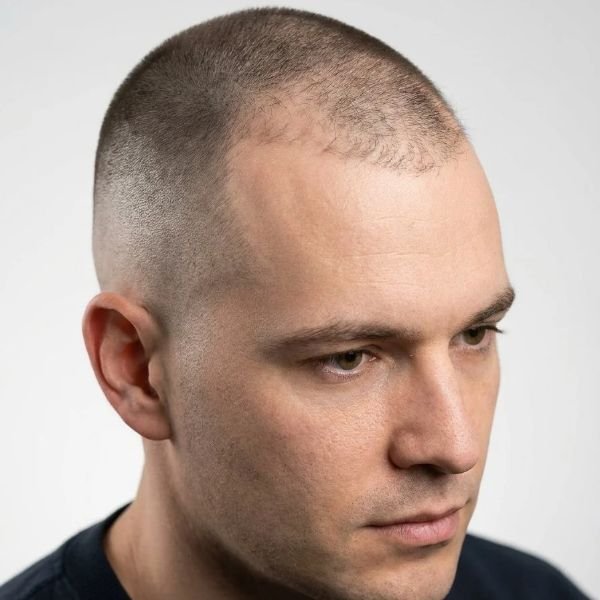
A fade can improve a buzz cut, but it is not automatically helpful for every hairline.
The important issue is where the fade starts and how much contrast it creates.
When a fade helps
A fade can add structure around the sides and back.
It may work particularly well when:
- Your face benefits from tighter sides.
- Your hairline is receding mainly at the temples.
- You want a modern version of the buzz cut.
- Your top still has enough density to create a clear transition.
- Your barber understands how to avoid isolating the weak areas.
A taper can also create a softer transition than an aggressive skin fade.
The best result usually comes from treating the top and sides as two separate decisions. You can have a #2 on top while using a taper or fade around the sides.
When a fade hurts
An aggressive fade can make a weak hairline appear more prominent if it creates too much contrast.
This is especially important when the temples are already sparse.
A very high fade can visually isolate the remaining hair on top. If the top is thin, that contrast may draw attention directly toward the areas you wanted to de-emphasize.
Some current barber guides specifically caution against very high fades when the recession or thinning is already prominent.
If you are unsure, ask your barber for a conservative taper or medium fade first.
Buzz cut, Caesar cut, textured crop, or shaved head?
A buzz cut is not the only answer.
Your best choice depends on how much density remains and whether you want to accept, soften, or partially cover the hairline.
| Style | Best for | Advantage |
| Buzz cut | Recession with decent overall density | Simple and balanced |
| Caesar cut | Recession with usable front density | Short fringe can soften the hairline |
| Textured crop | Temples with strong center density | Texture breaks up the hairline |
| Shaved head | Advanced thinning or very low density | Creates complete visual consistency |
A Caesar cut keeps a little more length at the front. The short fringe can soften the transition around the forehead.
A textured crop works similarly but gives you more movement. Texture can break up the straight visual line of the hairline instead of attempting to completely conceal it.
A shaved head becomes more attractive when the remaining hair no longer improves the overall appearance.
Current barber-focused guides commonly recommend short textured crops and buzz cuts among the practical options for receding temples.
The signs your bad hairline is pushing you toward shaved
A shaved head may be worth considering when:
- Your top has become noticeably thin.
- A #1 looks better than a #2.
- A #0 looks better than a #1.
- Longer hair creates obvious see-through areas.
- You spend more time hiding your hairline than styling your hair.
- The crown is thinning along with the front.
- You already prefer the clean appearance of very short hair.
The key test is not how much hair you have.
It is whether the remaining hair improves the overall shape.
If extra length creates patchiness, contrast, or an obvious attempt to cover recession, removing that extra length can sometimes produce a stronger look.
How to decide without regretting the cut
Going from longer hair to a #0 can feel dramatic. You do not have to make the decision all at once.
Use a gradual approach.
1. Start with #3
This lets you see your basic head shape and hairline while keeping reasonable coverage.
2. Move to #2
If #3 still emphasizes the recession, ask your barber to take it down to #2.
3. Compare #1
If #2 still leaves too much contrast, try #1.
4. Consider #0 or shaving
Only go this short if you prefer the appearance after seeing the shorter versions.
This approach is practical because hair can be removed during the haircut, but it cannot immediately be put back.
Also consider your face shape.
A very short buzz can emphasize facial structure. Strong jawlines often pair naturally with extremely short hair, while longer or narrower faces may benefit from keeping slightly more length. That does not create a universal rule, but it is worth discussing with your barber.
Final answer: does a buzz cut make a bad hairline better or worse?
A buzz cut can make a bad hairline look better, but the right length matters.
For most men, #1 or #2 is the best starting point. A #2 is usually the safer choice if you still have good density. A #1 can look stronger when recession is more obvious. A #3 is better suited to early recession with strong density, while #0 is useful when you are already comfortable with an extremely short or near-shaved look.
The goal is not to make the hairline disappear.
The goal is to make the entire haircut look intentional.
If shortening the hair makes the temples blend into the overall shape, the buzz cut is probably helping. If going shorter simply exposes increasingly thin areas, a shaved head or a different short hairstyle may look better.
When in doubt, start longer and work shorter.
That gives you more control and makes it easier to find the length that actually suits your hair density, face, and comfort level.
Frequently Asked Questions
Does a buzz cut make a bad hairline look better?
Yes, often. A short, uniform cut can reduce the contrast between receding areas and fuller hair, making the hairline look cleaner and more intentional.
What buzz cut length is best for a bad hairline?
A #1 or #2 is usually the best starting point, with #2 offering more coverage and #1 creating a sharper, shorter appearance.
Does a fade help a receding hairline?
A fade can help when it creates balanced proportions, but an overly high or aggressive fade can increase contrast around already thin temples.
Is a Caesar cut or textured crop better than a buzz cut for a bad hairline?
It can be. A Caesar or textured crop is useful when you still have enough front density to use a short fringe or texture to soften the hairline.
When does a shaved head look better than a buzz cut?
A shaved head can look better when the remaining hair is thin enough that extra length creates patchiness or obvious contrast instead of improving the overall shape.
Is #1 or #2 better for a receding hairline?
#2 is generally the safer first experiment, while #1 can work better when recession is more pronounced and you prefer a very short style.
Can a buzz cut stop a receding hairline?
No. A buzz cut changes the appearance of the hair but does not stop the underlying process of hair loss.

Noah is a passionate fashion writer who enjoys exploring the latest fashion trends, outfit ideas, styling tips, hairstyles, and seasonal looks. With a strong interest in modern style, Noah creates simple and helpful content to inspire readers and make fashion easier to explore. His goal is to share fresh ideas that help everyone feel confident in their personal style.
