


Crown balding rarely announces itself. The top back of your head is the one spot you almost never see, so the first clue is often a photo someone snaps from behind or a barber who goes quiet for a second. If you are searching for crown balding stages, you are probably asking one practical question: is this still early, or is it time to change something?
This guide walks through five visual stages of crown hair loss, from the first soft thinning to a crown that merges into the rest of the top. You will also get a simple way to track changes at home, a clear list of red flags, and a plan for each stage.
Quick answer: the five crown balding stages
- Subtle crown thinning: the whorl looks wider or flatter, but nothing is consistent yet.
- Repeat scalp visibility: the crown shows scalp in photos, bright light, or short cuts.
- Small visible bald spot: a defined thin or bare patch at the vertex.
- Expanding crown loss: the patch widens and the edges blur.
- Crown loss blending into broader top thinning: the crown and the mid scalp start to merge.
What doctors mean when crown balding starts to progress
Crown balding is also called vertex hair loss. In most people it is a form of androgenetic alopecia, better known as male or female pattern hair loss. Genetics make some follicles sensitive to dihydrotestosterone (DHT), a hormone made from testosterone. Over time, those follicles shrink. Doctors call this miniaturization.
A miniaturized follicle does not die overnight. It grows a shorter, finer hair with each cycle. Eventually the hair is so thin that it barely covers the skin. That is why early crown thinning looks like “less hair” before it ever looks like “no hair.”
Clinicians usually classify this with two tools:
- The Hamilton-Norwood scale for men. It has seven main stages, plus a variant called Norwood 3 Vertex for people whose loss starts at the crown while the hairline stays close to normal.
- The Ludwig scale for women. It has three stages and typically shows diffuse thinning on top with the frontal hairline preserved.
The five stages in this article are a practical, visual way to read the crown. They are not official medical grades, and they do not run on a fixed calendar. Some people sit at one stage for years. Others move faster. Use the stages to describe what you see, then confirm what is happening with a professional.
Stage 1: Subtle crown thinning
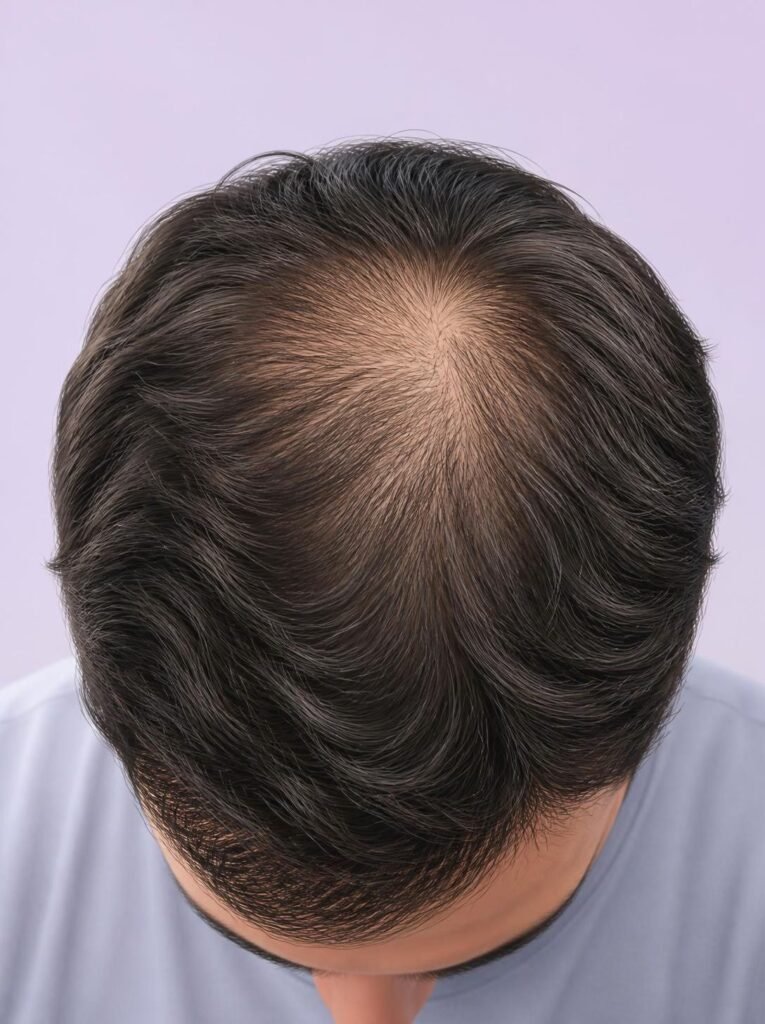
At this point, you may not be sure anything is happening. That doubt is normal.
What it looks like
- The whorl seems a little wider than it used to be.
- Hair at the crown lies flatter and feels finer.
- Scalp peeks through when your hair is wet, freshly washed, or under strong overhead light.
- The sides and back of your head still look full by comparison.
Why it is easy to miss
Light, hair color, and hair texture change how much scalp you see. Fine or curly hair can show the scalp sooner, while thick dark hair can hide early change. A single bad photo proves nothing.
What to do
Take a baseline. Photograph your crown in the same light, once, and save it. Note whether a parent, grandparent, or sibling has pattern hair loss, because family history raises the odds. Stay calm, keep your scalp clean, and do not rush into products that promise miracles.
Stage 2: Repeat scalp visibility
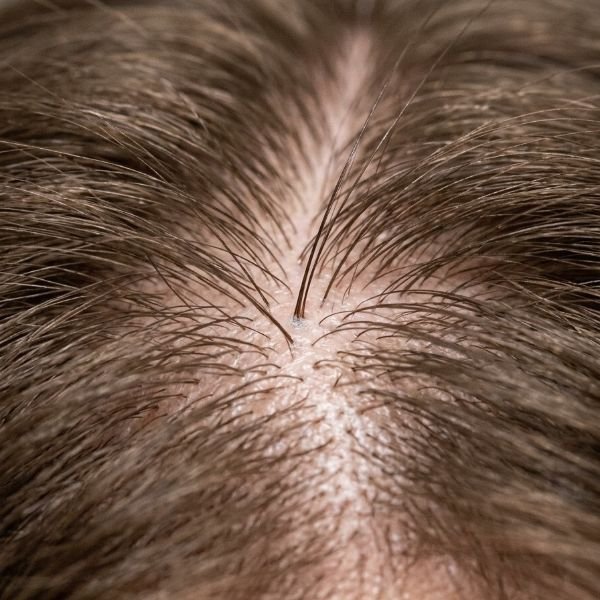
Stage 2 is where the pattern stops being a one-off. The crown shows scalp again and again, across different days and different lighting.
What it looks like
- Scalp shows in several photos taken over a few weeks.
- The area looks slightly larger than it did a month or two ago.
- Short haircuts make the crown stand out more.
- The hair around the crown also looks weaker, not only the center.
This is also the stage where people notice more hair in the shower drain or on a brush. Losing roughly 50 to 100 hairs a day is normal. What matters is the trend: a visibly thinner crown that does not bounce back.
Stage 2 is usually the best time to get honest
If you have been telling yourself it is just the light, this is the moment to stop. Follicles at this stage are usually shrunken, not gone. Treatments for pattern hair loss tend to work best when there is still hair to protect.
A dermatologist or trichologist can examine the scalp, check the pattern, and rule out other causes. That visit can save you months of guessing. It also gives you a plan before the spot becomes obvious.
What to do
- Book a scalp exam with a dermatologist.
- Ask about evidence-based options such as topical minoxidil and, for men, oral finasteride. Both are FDA approved for pattern hair loss, and both need months of steady use before you can judge results.
- Start a monthly photo routine (details below).
Stage 3: Small visible bald spot on the crown
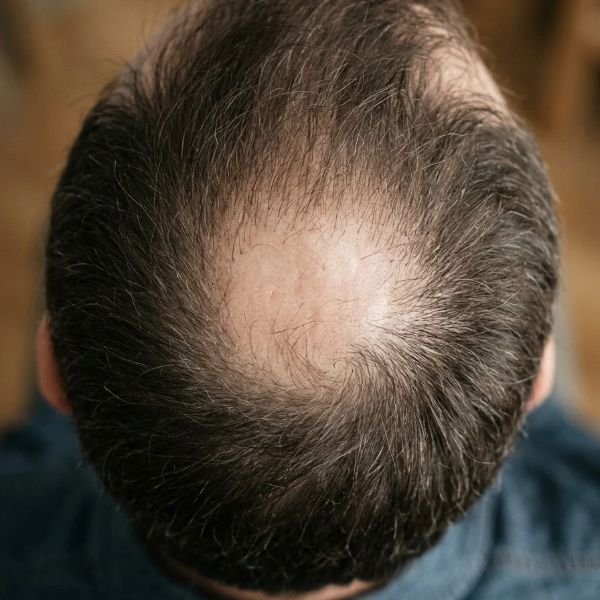
By Stage 3, the crown has a defined thin or bare patch. It is usually roughly round and sits at the vertex. In Norwood terms, this resembles Norwood 3 Vertex, where crown loss appears while the front hairline is not far gone.
What it looks like
- A small, clear area where scalp shows even when hair is dry and styled.
- A few fine, short hairs inside the patch, with fuller hair around the edge.
- A visible spot in selfies taken from above or in mirrors that show the back of your head.
- Friends or a partner may point it out.
Why it matters
The crown tends to keep spreading in pattern hair loss. A small spot today is often a larger spot later if nothing changes. That does not mean panic. It means this is a good decision point.
What to do
- Confirm the diagnosis with a clinician if you have not already.
- Stay consistent with medical treatment if you started one. Judge it over six to twelve months, not six weeks.
- Consider cosmetic tools while you wait: a shorter cut, hair fibers, or a style that sits well over the vertex.
- Ask about add-ons such as low-level laser devices. Evidence is modest, so treat them as support, not a replacement for proven treatment.
Stage 4: Expanding crown loss
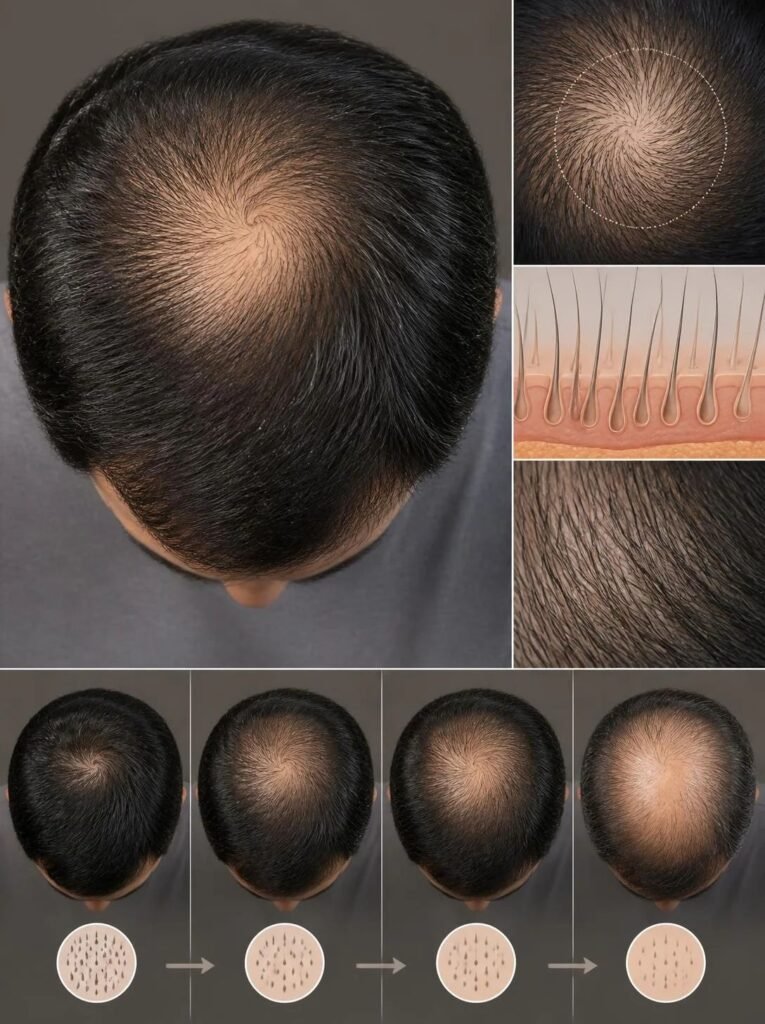
At Stage 4, the spot widens and the edges stop looking crisp. The thinning fades outward into the surrounding hair, so the whole crown looks softer and more open.
What it looks like
- The patch is clearly bigger than it was a year ago.
- The edges blur rather than ending in a clean circle.
- A band of hair usually still separates the crown from the front and mid scalp (similar to Norwood 4).
- The loss is noticeable from behind, in overhead light, and in windy weather.
What changes at this stage
Hair that is only a little thinner can still be saved. Hair that is already bare is much harder to bring back. So the question shifts from “Is this happening?” to “How much do I want to hold, and how much do I want to cover?”
What to do
- Review your treatment plan with your dermatologist. A stalled plan might need adjusting.
- Look at procedures if you want density back. Scalp micropigmentation can create the look of a shaved, fuller crown. A hair transplant can restore coverage, but it depends on your donor area, which is the permanent hair at the back and sides.
- Be realistic about haircuts. Longer top styles can make a growing crown look worse, not better.
Stage 5: Crown loss blending into broader top thinning

At Stage 5, the crown no longer reads as an isolated spot. The band of hair between the crown and the front thins out, and the two areas begin to join. This lines up with Norwood stages 5 and 6.
What it looks like
- Scalp visibility across the crown and the mid scalp at the same time.
- A larger bald or very thin area on top.
- A fringe of stronger hair around the sides and back.
What to do
This is the stage where many people choose between three paths:
- Keep fighting. Stay on medical treatment to protect the hair you still have.
- Restore. Plan a transplant with a surgeon who will talk honestly about donor supply and long-term pattern progression.
- Simplify. Shave or clipper cut the whole head and let the pattern stop being a daily problem.
None of these is the “right” answer. They are different trades between time, money, and comfort.
How to tell whether your crown is getting worse
Your eyes and mirrors lie. Photos do not, as long as you control the setup.
A simple monthly check
- Pick one day each month.
- Use the same bright, overhead light.
- Keep your hair at the same length and the same wetness (dry works best).
- Hold your phone at the same height and angle, or use a second mirror.
- Take one wide shot and one close shot of the crown.
- Compare this month to three months ago, not to last week.
Signs the crown is truly progressing
- Scalp is visible across several months of photos.
- The area is larger or the edges are more blurred.
- Hair strands near the crown are shorter and finer than elsewhere.
- Shorter haircuts expose more than before.
Crown balding or something else?
| Sign | More like crown balding | More like a cowlick or temporary shedding |
| Timeline | Slow change over months | Looks the same over time, or a sudden burst of shedding |
| Pattern | Thinning around the vertex, fine short hairs | A swirl that sits flat but hair density is normal |
| Short cuts | Scalp still shows | Scalp stops showing |
| Trigger | Often runs in the family | Often follows illness, major stress, or crash dieting |
Temporary shedding, known as telogen effluvium, usually shows up weeks to a few months after a trigger and tends to be spread across the whole scalp. It often improves on its own.
See a professional soon if you notice:
- Sudden, smooth, round patches
- Redness, scaling, itching, burning, or pain on the scalp
- Broken hairs or patchy loss after tight hairstyles
- Fast shedding with fatigue or other symptoms
- Any hair loss that worries you or hurts your confidence
Those signs can point to conditions other than pattern hair loss, such as alopecia areata, a fungal infection, or a scalp inflammation. These need a different plan.
What to do at each stage
Use this as a quick map, then personalize it with a clinician.
| Stage | Main goal | Smart next step |
| 1. Subtle thinning | Observe | Baseline photos, family history check |
| 2. Repeat scalp visibility | Diagnose and protect | Dermatologist visit, discuss proven treatment |
| 3. Small bald spot | Stabilize | Stay consistent, add cosmetic cover |
| 4. Expanding crown | Decide how much to hold or cover | Review the plan, explore SMP or transplant consult |
| 5. Blending into top thinning | Choose a direction | Maintain, restore, or go short |
A few extra points:
- Women: Crown thinning often looks like a wider part or diffuse thinning instead of a round spot. Finasteride is not used the same way for women, so get tailored advice from a dermatologist.
- Young adults: Pattern hair loss can start in the late teens or twenties. Starting early is possible and often helpful.
- Supplements and shampoos: They can help scalp health or fix a true deficiency, but they do not replace treatment that targets DHT sensitivity.
Final answer: what the crown balding stages really tell you
Crown balding stages describe a direction, not a deadline. Early on, the right moves are simple: watch, photograph, and get checked. Once scalp visibility repeats, you have a reason to act. When a bald spot forms and spreads, you have real choices to make about treatment, cover, and style.
The most useful habit is a monthly photo in the same light. The most useful decision is to see a dermatologist at Stage 2 or 3, instead of Stage 5. And the most useful mindset is calm. Hair loss on the crown is common, well studied, and manageable, whichever route you take.
Frequently Asked Questions
What are the crown balding stages?
They run from subtle crown thinning to repeat scalp visibility, then a small bald spot, an expanding crown, and finally crown loss that blends into broader top thinning.
How can I tell early crown balding from a normal crown swirl?
A normal swirl looks the same over time and stops showing scalp at short lengths. Crown balding gets more visible across months of photos and lighting.
Does crown balding always mean I should shave my head?
No. Many people keep their hair, use medical treatment, or add cover options. Shaving is a choice, not a requirement.
Can crown thinning happen without a receding hairline?
Yes. Crown loss can start first, which Norwood scale describes as Stage 3 Vertex. Women commonly have crown or top thinning with a preserved hairline.
When should I talk to a professional about crown hair loss?
See a dermatologist once scalp visibility repeats, or right away if you have sudden patches, scalp pain, redness, flaking, or rapid shedding.
Want a no-stress shave decision?
If you are leaning toward clippers, test the idea before you commit. Ask yourself three questions:
- Does the crown show at the length you normally wear your hair?
- Have you given a proven treatment a fair run, and is the spot still growing?
- Are you spending more energy hiding the crown than enjoying your hair?
If you answered yes to most of these, a short cut or a full shave may feel like relief, not defeat. Try a longer buzz cut first, such as a number 3 or 4 guard, and see how it looks in photos from behind. Many people find that a clean, even length looks sharper than thinning hair left long.
Whatever you choose, make it on your timeline and with real information. This guide is educational and does not replace a diagnosis from a licensed professional.

Noah is a passionate fashion writer who enjoys exploring the latest fashion trends, outfit ideas, styling tips, hairstyles, and seasonal looks. With a strong interest in modern style, Noah creates simple and helpful content to inspire readers and make fashion easier to explore. His goal is to share fresh ideas that help everyone feel confident in their personal style.
