


A skin fade buzz cut with a receding hairline can look sharp and deliberate. It can also turn the temples into the first thing people notice. The difference comes down to three choices: fade height, guard length on top, and how the hairline is finished.
This guide explains when the cut works, when it backfires, and exactly what to say in the barber chair. You will also find a guard chart, advice for different recession patterns, and tips on beards, glasses, and necklines.
Key takeaways
- A skin fade works best with mild to moderate recession and good density on top.
- A low or mid fade is safer than a high fade when the temples are thinning.
- A number 2 or 3 guard on top is the best starting point for most men.
- Avoid a hard, ultra-sharp line-up. It pushes the hairline back visually.
- A beard blended into the fade can add balance, but it will not fix a poor cut.
Quick answer: when does a skin fade work with recession?
A skin fade works with a receding hairline when the hair on top is dense enough to look intentional and the fade starts low enough to leave some frame around the temples. In that case the contrast makes the top look thicker. It does not work well when the front is sparse, the fade is high, or the crown is thinning too.
Use this quick check:
- Good fit: mild recession, dense top, low to mid skin fade, number 2 or 3 guard.
- Maybe: clear M-shape with a full centre, low skin fade, slightly longer top, soft hairline.
- Poor fit: thin front, diffuse thinning, or advanced loss with a crown that shows through at buzz length.
Why a skin fade can expose the temples
A skin fade removes hair down to bare skin on the sides and back. That creates strong contrast between skin and the hair above it. On a full head of hair, the contrast makes the top look thicker. On a receding hairline, the same contrast can make the temples look deeper.
Here is why the cut can go wrong:
- Lost framing. Hair beside the temples normally softens the corners of the hairline. Take it to skin and the corners stand alone.
- High fade lines. A fade that starts near the temple rises into the area where recession is already happening, so the line and the hairline meet.
- Very short top. A number 0 or 1 on top shows scalp through thin areas and gives the eye nothing to follow.
- Sharp line-ups. A razor-straight edge across the forehead and temples can carve the hairline back a little more at each visit.
The fix is not to avoid skin fades. It is to control how much contrast you create and where you create it. Keep the fade lower, leave a little more length on top, and finish the hairline softly.
Who can pull off a skin fade buzz cut?
Your recession pattern matters more than the haircut name. Barbers often judge the cut by hairline shape, density, and the scalp visible at buzz length. Here are the four most common situations.
Mild recession with dense coverage
This is the best case. The corners have moved back slightly, but the front and top are full. A skin fade here looks clean, and the dense top reads as thick against bare sides.
- Choose a low or mid skin fade.
- Use a number 2 or 3 guard on top.
- Keep the front edge natural rather than razor-cut.
If your hair is dense and you like a very short look, you can try a number 1. Check the result in a mirror from the front and the side before you commit to it again.
M-shaped recession
An M-shaped hairline has deep corners and a central peak. A buzz cut with a skin fade can work, but the shape of the fade matters.
- Start the fade low so the temples keep some frame.
- Leave a little more length at the front of the top, around a number 3, so the peak and corners blend.
- Ask the barber to follow the natural hairline instead of squaring it off.
Some men embrace the M-shape with a slight V-style finish at the front. It can look natural, but only if the edge is soft. A hard, drawn-on V often looks fake.
Thin front or diffuse top
When the front is thin, or the top thins evenly instead of in corners, a skin fade can look severe. The bare sides make the see-through areas on top more obvious.
A softer option usually works better:
- A taper fade instead of a skin fade, so some hair stays at the sides.
- A number 3 or 4 guard on top for a bit more coverage.
- A uniform buzz cut with no fade at all, if the top is very thin.
Crown thinning as well as recession
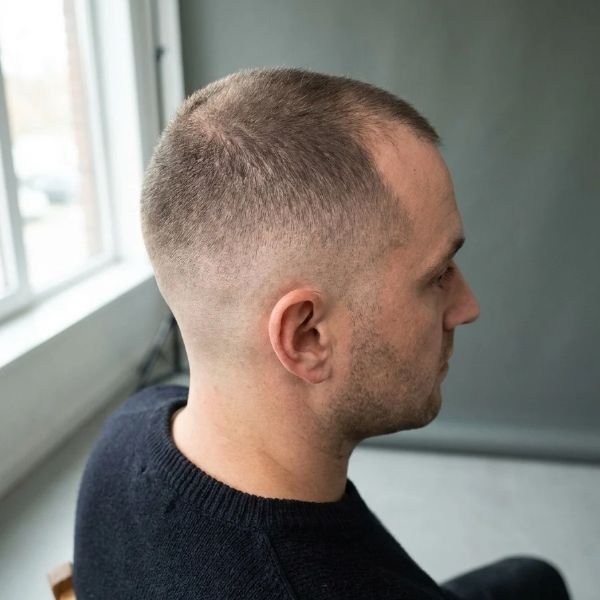
Recession plus a thinning crown is the toughest pattern for a fade. At buzz length, the crown shows scalp and the hairline pulls back from the front. The whole top can look patchy.
In this case, many barbers suggest one even length all over, or a very short shave, rather than a high-contrast fade. If you still want a fade, keep it low and use a slightly longer guard on top. You should also see a doctor or dermatologist, because early treatment can slow further loss.
Choose the guard before you choose the drama
The guard on top decides how thick your hair looks. The fade decides how much contrast surrounds it. Most men pick the fade first and the guard second. Reverse that order.
| Guard | Approx. length | Best for |
| Number 1 | 1/8 in (3 mm) | Dense hair and a tidy, even hairline |
| Number 2 | 1/4 in (6 mm) | Most men with mild to moderate recession |
| Number 3 | 3/8 in (10 mm) | Visible M-shape or thinner front |
| Number 4 | 1/2 in (13 mm) | Thin top, soft look, easier grow-out |
Guard lengths vary slightly between clipper brands. Ask your barber to show you the guard before cutting.
A practical rule: if you are unsure, go one guard longer than you think you need. You can always cut it shorter next time. You cannot add hair back.
Beard, glasses, and neckline: build balance below the fade
A haircut sits inside a bigger picture. A receding hairline looks more or less prominent depending on what happens around it.
- Beard: A neat beard adds weight to the lower face and moves attention away from the temples. Blend it into the fade at the sideburns so there is no abrupt gap.
- Glasses: Frames sit across the face and draw the eye to the middle of it. Thicker frames can balance a high forehead. Thin frames can make the forehead look larger.
- Neckline: A tapered neckline looks more natural and keeps the back of the cut in proportion with the sides. A square block cut can look severe.
- Eyebrows and skin care: Well-kept brows and healthy skin help the face, not the hairline, become the focal point.
Do not try to ‘fix’ a harsh fade with a bigger beard
A large beard cannot rescue a fade that is too high or a top that is too short. It only adds more contrast to an already stark cut. Fix the haircut first. Then shape the beard to support it, with a clean cheek line and a smooth blend at the sideburns.
What to ask your barber
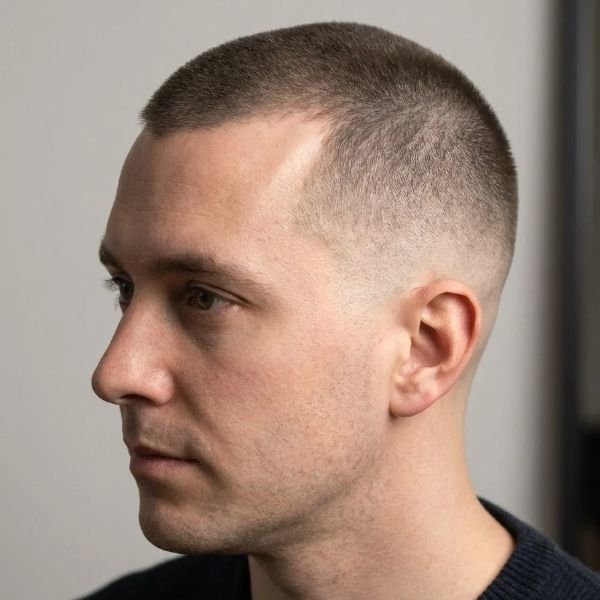
Vague requests lead to surprises. Be specific about four things: fade height, guard length, hairline finish, and beard blend.
- Fade height: “A low skin fade” or “a mid skin fade, starting below the temple.”
- Guard on top: “A number 2 on top” or “a number 3 at the front.”
- Hairline finish: “Keep the front natural. No hard line-up.”
- Beard blend: “Blend the beard into the fade at the sideburns.”
Sample script you can use:
“I have some recession at the temples. I would like a low skin fade, a number 2 on top, a natural hairline with no sharp line-up, and my beard blended into the sides. Please start a little longer and we can go shorter if it looks right.”
Bring a photo of someone with a similar hairline. Show it to your barber and ask whether it will work for your head shape and density. A good barber will tell you honestly if it will not.
Upkeep tips:
- Expect a fresh cut every 2 to 3 weeks. Skin fades grow out quickly.
- Moisturise and use sunscreen on exposed scalp.
- Avoid over-trimming the front at home. It can push the hairline back.
Final verdict: sharp when it supports the whole shape
A skin fade buzz cut with a receding hairline can work well. It works best when recession is mild to moderate, the top is dense, the fade is low or mid, and the hairline is finished softly. It works poorly when the front is thin, the crown is thinning, or the cut is set too short and too high.
Start longer than you think. Use a number 2 or 3 on top. Keep the fade low. Ask for a natural edge, and let the beard, glasses, and neckline support the shape. If the result still feels too stark, move to a taper fade or a uniform buzz.
If your hairline is changing quickly, speak to a doctor or dermatologist. Treatments for male pattern hair loss work best when started early, and a professional can tell you what is suitable for you. A haircut changes how recession looks. It does not change what is happening on the scalp.
Frequently Asked Questions
Is a skin fade buzz cut good for a receding hairline?
Yes, if recession is mild to moderate and the top is dense. A low or mid skin fade with a number 2 or 3 guard usually looks cleanest.
Will a skin fade make my receding hairline look worse?
It can if the fade is too high or the top is too short. Bare skin beside the temples increases contrast and makes the corners look deeper.
What guard should I get with a skin fade and receding hairline?
A number 2 or 3 guard on top is the safest start. A number 1 only suits dense hair and a tidy hairline.
Should I get a high skin fade if I am thinning?
Usually no. A high fade removes the hair that frames the temples, so a low or mid fade is the safer choice.
Does a beard help balance a skin fade buzz cut?
Yes. A groomed beard adds weight to the lower face and pulls attention from the temples, as long as it blends smoothly into the fade.
This article is general grooming guidance, not medical advice. If you are worried about hair loss, see a qualified doctor or dermatologist.

Noah is a passionate fashion writer who enjoys exploring the latest fashion trends, outfit ideas, styling tips, hairstyles, and seasonal looks. With a strong interest in modern style, Noah creates simple and helpful content to inspire readers and make fashion easier to explore. His goal is to share fresh ideas that help everyone feel confident in their personal style.
