


A crown can be surprisingly difficult to judge. The hair naturally grows in a circular pattern called a hair whorl, and that pattern can expose some scalp even when hair density is completely normal. Overhead lighting, wet hair, short haircuts, and phone cameras can make the area look even thinner.
The bigger question is not simply, “Can I see my scalp?” Instead, ask whether the visible area is stable or changing. A normal crown usually keeps a similar shape over time. Crown thinning tends to become wider, more transparent, or more noticeable as surrounding hairs lose density.
Male pattern hair loss, also called androgenetic alopecia, commonly affects the crown or vertex as well as the frontal and temple areas. It generally develops gradually.
This guide explains five practical signs that can help you compare a normal crown with possible balding. It also explains how to photograph the crown, what can fool you, and when professional evaluation makes sense.
Quick answer: normal crown vs balding crown
The easiest distinction is stability versus progression.
A normal crown can show a small amount of scalp directly around the center of the whorl. The surrounding hair may still look thick and evenly distributed. The appearance can change significantly depending on hair length, direction, moisture, and lighting.
A potentially balding crown usually shows a broader pattern. The visible scalp may extend beyond the natural center of the whorl, and the hair surrounding it can become finer or less dense. The change tends to become more obvious over months rather than appearing only in one photograph.
| Sign | More consistent with a normal crown | More concerning for crown thinning |
| Scalp visibility | Mostly centered around the whorl | Spreads outward |
| Hair around center | Looks relatively full | Looks finer or weaker |
| Lighting | Mainly visible under harsh light | Visible under ordinary lighting |
| Time | Looks similar over months | Gradually becomes more noticeable |
| Rest of top | Density appears stable | Other top areas also look thinner |
| Haircut | Appearance changes with length | Same thinning pattern remains |
A visible crown alone does not prove balding. Hair-loss diagnosis is based on the overall pattern and progression, not simply how much scalp appears in the center.
Why a normal crown can still look thin
The crown is one of the easiest areas of the scalp to misread. Hair does not grow straight backward from the crown. Instead, follicles follow a whorl pattern that causes individual hairs to separate and point in different directions.
This creates a natural opening in the center. Depending on your hair density, that opening may reveal a small amount of scalp. Two people with equally healthy hair can therefore have very different-looking crowns.
Hair length also changes the appearance. Longer hair can overlap across the whorl and provide more visual coverage. Very short hair may separate more clearly around the center and make the scalp easier to see.
Lighting can make the difference dramatic
Direct overhead light is particularly misleading. Light hits the exposed scalp and reflects toward the camera, making the crown appear much brighter than the surrounding hair.
Wet or oily hair can create a similar effect because strands group together. This reduces the number of visible hair shafts covering the scalp.
A better comparison uses:
- Dry hair
- Normal indoor lighting
- Soft daylight
- The same camera angle
- Similar hair length
- Similar hair direction
The goal is not to find the most flattering photograph. It is to create a repeatable comparison.
One dramatic crown photo is weak evidence
A single photograph cannot reliably tell you whether a crown is naturally open or progressively thinning.
Photos can exaggerate scalp visibility because of flash, overhead lighting, camera exposure, wet hair, hair products, or an unusual angle. A close-up image can also make a small area look much more significant than it does in everyday life.
A stronger approach is to compare several photographs taken over time. If the crown looks essentially the same under similar conditions, that is more reassuring than one alarming image.
Progressive hair loss is generally recognized through changes in density and distribution. Dermatologists may also use magnification or trichoscopy to examine hair shaft thickness, follicle changes, and density when the diagnosis is uncertain.
The key lesson is simple: trend evidence is stronger than photo evidence from one day.
The five strongest clues that it may be real crown thinning
Not every visible crown means hair loss. However, several clues become more meaningful when they appear together.
1. The visible area is getting wider
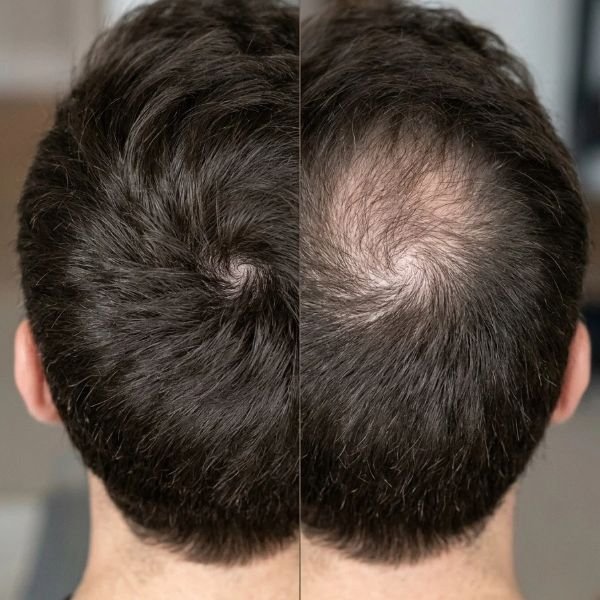
One of the strongest warning signs is gradual expansion.
A normal whorl can be visible for years. Its center may look slightly larger under certain lighting, but the basic pattern generally remains stable.
With crown thinning, the visible scalp can begin extending beyond the original center. You may notice that the area looks wider from the back or that more scalp appears between the hairs surrounding the whorl.
Try comparing photographs taken several months apart rather than checking your crown repeatedly throughout the day.
Look for:
- A wider area of visible scalp
- Less overlap between nearby hairs
- More transparency around the whorl
- A gradual increase rather than a one-day change
Progression is important because androgenetic alopecia is a patterned and generally progressive form of hair loss.
2. The hair around the swirl looks weaker too
The center of the crown is not the only area to examine.
Healthy-looking density around the whorl can make a naturally visible center look much less concerning. If the surrounding hairs begin looking finer, shorter, flatter, or less capable of covering the scalp, the pattern becomes more suspicious.
This happens because pattern hair loss can involve miniaturization, where affected follicles progressively produce thinner and shorter hairs.
Instead of asking only, “Can I see skin?” ask:
Do the hairs around the visible area still look as strong as they used to?
That question provides more useful information than focusing exclusively on the center.
3. It shows up in normal light
Lighting is a major source of false alarms.
If you can only see the crown when standing directly underneath a bright ceiling light, that is weaker evidence of actual thinning. The same is true if the scalp becomes visible only when your hair is wet or heavily separated.
Concern increases when the same pattern is visible under ordinary conditions.
For example, you might notice the crown:
- In normal bathroom lighting
- In soft daylight
- In ordinary photographs
- With dry hair
- Without deliberately separating the strands
Repeated visibility across different conditions is more informative than an extreme lighting setup.
Still, this does not provide a diagnosis. A naturally open whorl can remain visible under many types of lighting.
4. Shorter hair reveals the same pattern
A short haircut can make crown changes easier to see.
When hair is longer, strands can overlap and hide areas of scalp. After a shorter haircut, the hairs stand apart more clearly. This can reveal the natural whorl even when there is no significant hair loss.
That means a freshly exposed crown after a haircut is not automatically evidence of balding.
The useful question is whether the same pattern appears at different hair lengths and remains consistent over time.
If the crown looks more open after every short haircut, compare it with older photographs taken at a similar length. This removes some of the confusion created by styling.
Haircuts are useful for observation, but they cannot determine whether follicles are miniaturizing.
5. The rest of the top is changing too
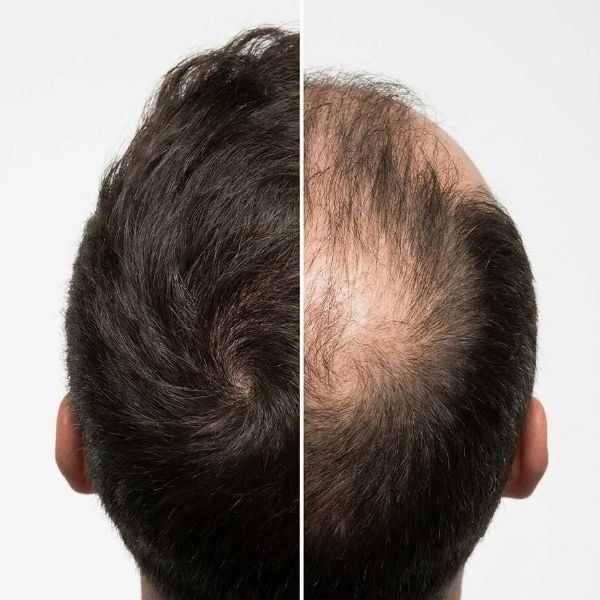
Crown thinning becomes more meaningful when it is part of a larger pattern.
Male pattern hair loss commonly affects the hairline, temples, and crown. In some people, the crown becomes noticeable first. In others, recession at the temples appears earlier.
Look at the entire top of your scalp rather than inspecting one circle.
Possible signs include:
- A gradually receding hairline
- Thinner temples
- Reduced density across the top
- A crown that is becoming more transparent
- Increasing contrast between the top and sides
The sides and back often remain denser in classic male pattern hair loss, creating a recognizable distribution.
If several changes are occurring together, professional assessment becomes more useful than relying on a crown photograph alone.
The safest way to photograph your crown
Consistent photographs are one of the simplest ways to monitor a crown without constantly checking the mirror.
Take photographs under similar conditions each time. Do not deliberately create harsh lighting just to see how much scalp you can expose.
A useful routine is:
- Photograph the crown from directly above or from a consistent elevated angle.
- Keep your hair dry.
- Use similar indoor or daylight conditions.
- Avoid flash when possible.
- Keep your hair at a similar length.
- Take several views rather than one close-up.
- Compare photographs every few months.
Do not take dozens of photographs every day. Small daily differences are normal and can increase anxiety without providing useful evidence.
A monthly or every-few-months comparison can provide a clearer trend.
Crown whorl vs balding: what usually fools people
Several everyday factors can make a normal crown appear thinner.
A natural hair whorl: The circular direction of growth can create a visible center.
Overhead lighting: Direct light can illuminate the scalp between separated hairs.
Wet hair: Water causes strands to clump together, increasing scalp visibility.
Oily hair: Sebum can make individual hairs group together.
Short hair: Short strands may provide less overlap around the whorl.
Hair products: Gel, wax, pomade, or styling cream can separate strands.
Camera exposure: Smartphone cameras can brighten the scalp and increase contrast.
Hair direction: Brushing the hair away from its natural growth pattern can expose more skin.
These factors explain why the same crown can look thick in one photograph and thin in another.
The opposite mistake can also happen. Longer, carefully styled hair may hide genuine thinning. That is why repeatable photographs and changes over time are more useful than styling alone.
When to monitor, when to change the haircut, and when to ask a professional
If your crown looks slightly open but has remained stable for years, monitoring may be reasonable.
You can also choose a haircut that works with your natural growth pattern. A skilled barber can avoid creating excessive separation around the whorl and can use texture or length to improve coverage.
Consider professional evaluation if you notice:
- Progressive widening of the crown
- Increasing scalp visibility
- Noticeably finer hairs around the crown
- A receding hairline appearing at the same time
- Rapid or unusual shedding
- Sudden bald patches
- Hair loss that concerns you or is difficult to explain
A dermatologist can examine the scalp and determine whether the pattern is consistent with androgenetic alopecia or another cause of hair loss. Diagnosis can involve history, scalp examination, and sometimes trichoscopy or other testing.
This distinction matters because not every type of hair loss is pattern baldness.
What a preview can and cannot tell you
A crown preview, haircut preview, or shaved-head simulation can be useful for understanding how a different hairstyle might look.
It cannot reliably diagnose hair loss.
A preview may show how much scalp could become visible with shorter hair. It may also help you decide whether a buzz cut, textured crop, or another style would suit your current density.
However, an image cannot measure follicle health, hair shaft diameter, or true density accurately enough to replace an examination.
Think of a preview as a style-planning tool, not a medical test.
The same principle applies to online hair-loss calculators. They can help organize observations, but they should not be treated as definitive diagnoses.
Final answer: look for patterns around the crown, not panic in the center
The most important difference between a normal crown and a potentially balding crown is usually not whether you can see a little scalp. A natural hair whorl can expose the center and still have healthy surrounding density.
Pay more attention to change. A crown that is becoming wider, more transparent, and surrounded by finer hairs deserves closer monitoring. If the top and hairline are changing as well, the overall pattern becomes more important.
Take consistent photographs rather than relying on one dramatic image. Use normal lighting and compare similar hair lengths. If you see progressive change or remain unsure, a dermatologist can provide a more reliable assessment than a mirror or phone camera.
Frequently Asked Questions
How do I know if my crown is balding or just a normal whorl?
A normal whorl can show some scalp at the center while surrounding hair remains dense and stable. Crown balding is more likely when the visible area gradually expands and nearby hairs become finer or less dense.
Can a normal crown show scalp?
Yes. A normal crown can naturally expose a small amount of scalp because hair grows in a circular whorl, especially under overhead light or with short, wet, or separated hair.
What is the best way to track crown thinning?
Take consistent photographs every few months using similar lighting, angle, hair length, and dry-hair conditions, then compare the images for gradual changes.
Should I use a shaved-head preview if I am not sure my crown is thinning?
You can use a shaved-head preview to explore a hairstyle, but it cannot diagnose balding. A dermatologist is better equipped to assess progressive thinning or follicle changes.

Noah is a passionate fashion writer who enjoys exploring the latest fashion trends, outfit ideas, styling tips, hairstyles, and seasonal looks. With a strong interest in modern style, Noah creates simple and helpful content to inspire readers and make fashion easier to explore. His goal is to share fresh ideas that help everyone feel confident in their personal style.
