


Choosing between a number 1 and number 2 buzz cut can be surprisingly difficult when your hair is thinning or your hairline is receding. Both cuts are short, clean, and easy to maintain. The real difference is how much hair remains to soften the scalp and blend areas with different levels of density.
A number 1 buzz cut leaves roughly 3 mm of hair, while a number 2 leaves roughly 6 mm. These measurements are approximate because clipper brands, blade settings, guards, and cutting techniques can change the final result.
For many balding men, a number 2 is the better starting point because it gives some scalp coverage while still reducing the visual contrast between thicker and thinner areas. A number 1 can be better when the contrast between the remaining hair and the scalp is itself the main problem.
The right choice depends less on the number printed on the guard and more on your hair density, recession pattern, scalp visibility, head shape, and how short you are comfortable wearing your hair.
Quick answer: number 1 or number 2 for balding?
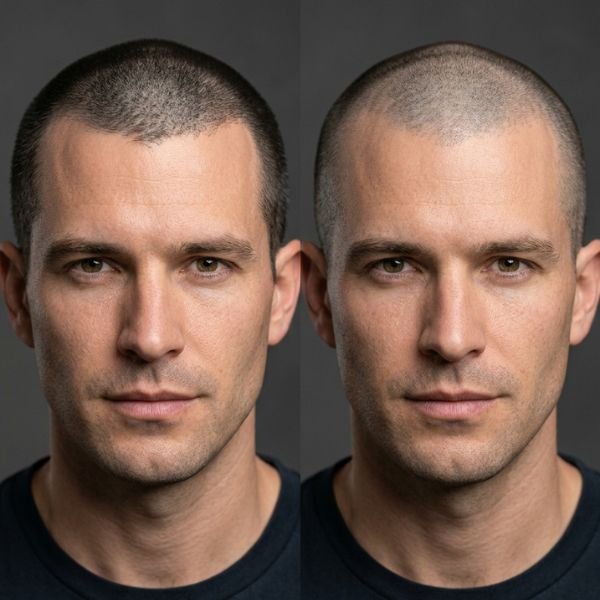
If you are unsure, start with a number 2 buzz cut.
At about 6 mm, a number 2 provides more visual coverage than a number 1 while still creating the clean, uniform appearance that makes buzz cuts useful for thinning hair. It is usually the safer first test for men who are nervous about exposing too much scalp.
Choose a number 1 when your hair is thin enough that extra length creates an obvious difference between thicker and weaker areas. At around 3 mm, the hair becomes more uniform visually, and the shorter length can make recession or thinning look more intentional.
| Feature | Number 1 Buzz Cut | Number 2 Buzz Cut |
| Approximate length | 3 mm | 6 mm |
| Scalp visibility | Higher | Lower |
| Overall appearance | Very short and sharp | Short with more softness |
| Coverage | Minimal | Slightly better |
| Best starting point | Men comfortable with very short hair | Men testing a buzz cut |
| Maintenance | Frequent | Frequent but slightly more forgiving |
| Effect on scalp contrast | Can reduce hair-to-hair contrast | Can soften scalp contrast |
The important point is that shorter does not automatically mean better for balding. The goal is to create the most balanced appearance for your particular pattern of hair loss.
A guard number is not a diagnosis
A clipper guard tells you how much hair is being left behind. It does not tell you how advanced your hair loss is or which hairstyle will suit you.
Hair loss can appear as temple recession, crown thinning, diffuse thinning, or a combination of patterns. Two men can have the same amount of hair but look very different with the same guard because their density and scalp contrast are different.
If you are experiencing sudden, patchy, or unusually rapid hair loss, a barber cannot diagnose the cause. A dermatologist or qualified medical professional is the appropriate person to discuss unexplained hair loss.
What actually changes between a number 2 and number 1
The difference is only about 3 mm, but visually it can be significant.
A number 2 leaves enough length for the hair to retain more visible color and texture. This can make the scalp less prominent, especially when the hair is dark and the scalp is lighter.
A number 1 moves closer to stubble territory. The scalp becomes easier to see, particularly under bright light. Instead of using length to create coverage, the haircut relies on uniformity.
This creates two different visual effects:
- Number 2 creates more softness.
- Number 1 creates more uniformity.
- Number 2 gives slightly more scalp coverage.
- Number 1 exposes more of the natural head shape.
- Both can reduce the obvious difference between longer, thicker sides and a thinner top.
That last point is why both lengths can work for balding men. A buzz cut removes the temptation to use longer hair to cover an area that no longer has enough density to support it.
Current buzz-cut guides consistently describe #1 as approximately 3 mm and #2 as approximately 6 mm, although exact measurements can vary.
Choose a number 2 when hair still contributes something useful
A number 2 is often the best choice when you still have reasonably even hair coverage but want to make thinning less noticeable.
Think of it as the softer test.
If your crown is slightly thin, your temples are receding, or your hair is becoming finer across the top, keeping 6 mm may provide enough texture to avoid making every scalp area highly visible.
A number 2 can be especially useful if:
- Your scalp is highly visible under bright light.
- You have fine but relatively even hair.
- Your thinning is mild or moderate.
- You are trying a buzz cut for the first time.
- You are unsure whether you want an extremely short appearance.
- You want some visual separation between your hair and scalp.
- Your head shape is something you have never exposed with a very short cut.
The number 2 also gives you a little more room to evaluate the haircut. If it still looks too long or if the thinner areas remain visually obvious, you can go shorter later.
That makes the #2 a practical starting point for many men. Several current guides similarly recommend starting longer when you are uncertain because a barber can remove additional length, while restoring length requires waiting for hair to grow.
Choose a number 1 when contrast is the problem
A number 1 can make sense when the problem is not simply thin hair but the contrast between different areas of your scalp.
For example, imagine that the sides still look dense while the crown is much thinner. Leaving the sides longer can make the crown appear even thinner by comparison.
Going down to a number 1 reduces the visual difference.
The same principle can apply to a receding hairline. Longer hair at the front may make the recession more noticeable if the hairline has lost density. A very short buzz makes the recession part of an intentionally short overall shape instead of a feature that the haircut appears to be trying to hide.
Choose a number 1 when:
- You prefer an extremely short haircut.
- Your hair is noticeably thin across the top.
- Longer sides create too much contrast with the top.
- You are comfortable with greater scalp visibility.
- You want a sharper, more stripped-back appearance.
- You do not mind trimming frequently to maintain the length.
However, a number 1 is not automatically better for advanced hair loss. If your scalp is very visible, the shorter length may actually make scalp show more obvious.
That is the key tradeoff.
A number 1 can reduce hair-density contrast while increasing scalp visibility.
Compare the cut away from the barber chair
A common mistake is judging a buzz cut only while sitting under a barber’s bright lights.
Lighting can dramatically change how thinning hair appears. A scalp that looks reasonably covered in normal indoor lighting can appear much more visible under direct overhead light.
Before choosing between #1 and #2, think about how the haircut will look in your normal life.
Consider these five situations
1. Natural daylight
Step outside and look at your hair from different angles. Pay particular attention to the crown.
2. Bathroom lighting
Strong overhead lighting can exaggerate scalp visibility. This is useful information, but it should not be your only reference.
3. Front and side views
Recession can look different from the front compared with a three-quarter view.
4. Crown visibility
Ask your barber to show you the crown with a mirror. If the crown becomes highly visible at #1, the #2 may be a better balance.
5. Your normal styling routine
If you want a haircut that requires almost no styling, both lengths are excellent. A buzz cut removes most of the need for combing, blow-drying, and styling products.
The goal is not to make your hair appear magically thicker. It is to make the overall haircut look deliberate and balanced.
When neither guard is the right endpoint
Sometimes the answer is neither #1 nor #2.
If a number 2 still leaves the top looking noticeably thin, but a number 1 exposes more scalp than you like, consider a middle or longer option.
A #1.5, for example, can sit between the two common lengths. A #3 can also provide more softness while remaining unmistakably short.
A longer buzz may be particularly useful if your hair has enough density to benefit from texture. Current guides commonly place #3 around 10 mm and #4 around 13 mm, giving progressively more coverage than #1 and #2.
You can also change the sides rather than simply shortening everything.
For example, a barber may keep the top at #2 and use a controlled taper or fade around the sides and neckline. The important consideration for thinning hair is not to create an overly dramatic difference that makes the top look weaker.
You may also decide that a fully shaved head is cleaner than a buzz if hair loss has progressed substantially. A buzz cut is a styling choice, not a treatment for hair loss. It does not regrow hair or reverse the underlying cause of thinning.
Final answer: use number 2 as the softer test, number 1 as the clearer test
For most men who are balding and unsure which guard to choose, start with a number 2.
It provides approximately 6 mm of hair, gives more scalp coverage than a number 1, and still creates the uniform appearance that makes a buzz cut useful for thinning hair.
Move to a number 1 when you decide that the remaining length is creating more visual contrast than benefit. At approximately 3 mm, the cut becomes more direct and exposes more scalp, but it can also make the overall pattern of hair loss look more intentional.
The simplest decision rule is:
Choose #2 if you want softness and some coverage. Choose #1 if you want maximum uniformity and are comfortable showing more scalp.
If neither looks right, do not force the decision. A #1.5 or #3 may give you a better balance.
Most importantly, tell your barber what you are trying to accomplish. Saying “I am thinning at the crown and want to reduce the contrast” is more useful than simply saying “give me a buzz cut.”
Frequently Asked Questions
Is a number 1 or number 2 buzz cut better for balding?
A number 2 is usually the safer starting point because it leaves more coverage, while a number 1 can work better when reducing contrast between thick and thin areas is the priority.
How short is a number 1 versus a number 2 buzz cut?
A #1 is approximately 3 mm or 1/8 inch, while a #2 is approximately 6 mm or 1/4 inch. Exact results vary by clipper and guard.
Does a number 1 buzz cut make thinning look worse?
It can make scalp visibility more obvious, but it may also reduce the contrast between thicker and thinner hair, so the effect depends on your density and hair-loss pattern.
Who should avoid a very short buzz cut?
Men who dislike visible scalp, have significant scalp irregularities or scarring, or are uncomfortable with an exposed head shape may prefer a longer buzz cut.
Is a number 2 buzz cut good for a receding hairline?
Yes. A #2 can make a receding hairline look more intentional while retaining slightly more coverage than a #1.
Can a buzz cut stop hair loss?
No. A buzz cut changes the appearance and maintenance of your hair but does not treat the underlying cause of hair loss.
Should I start with number 1 or number 2 if I have never had a buzz cut?
Start with #2 if you are uncertain. You can always ask your barber to shorten it afterward, but you cannot immediately add the lost length back.
Final Thoughts
The best buzz cut for balding men is not determined by a universal rule that says #1 is better or #2 is better. It depends on what your hair needs visually.
A number 2 is the more forgiving choice. It leaves enough length to soften scalp visibility while still giving you the clean, uniform appearance of a buzz cut.
A number 1 is the more decisive choice. It removes more length and can make uneven density less visually important, but it also exposes more of the scalp.
If you are standing between the two guards, start with #2. Look at your crown, temples, hairline, and overall head shape in normal lighting. If the extra length seems to emphasize the difference between your fuller and thinner areas, try #1 at your next trim.
The best result is the one that makes the haircut look intentional rather than one that makes you think about your hair loss all day.

Noah is a passionate fashion writer who enjoys exploring the latest fashion trends, outfit ideas, styling tips, hairstyles, and seasonal looks. With a strong interest in modern style, Noah creates simple and helpful content to inspire readers and make fashion easier to explore. His goal is to share fresh ideas that help everyone feel confident in their personal style.
