


A shaved head with stubble is one of the easiest looks to wear, but only when the stubble is deliberate. Too light and it vanishes. Too patchy and it looks accidental. Too long and you have quietly drifted into short beard territory.
This guide shows you which stubble lengths work best on a bare scalp, how to groom them, and how face shape and glasses change the answer. You will also get a simple way to test the look before you commit.
Quick answer: yes, a shaved head with stubble is often the safest choice
Yes. For most men, a shaved head with stubble looks good at 2 to 4 mm, trimmed evenly, with a clean neckline. It defines the jaw, balances a bare scalp, and takes far less upkeep than a full beard.
It is “safe” for three reasons:
- It adds lower face structure without hiding your jawline.
- It is easy to reverse. If you dislike it, you can shave it off in one pass.
- It reads as a style, not a statement, so it suits an office, a gym, and a night out.
The goal is controlled contrast
With no hair on top, your face has fewer details for the eye to settle on. That is why the head and the jaw need to work as a pair. In a shaved head with stubble, a smooth or very short scalp sets a clean outline. Stubble adds a soft, darker shape underneath it.
Controlled contrast means the two parts look related. The scalp and the beard are both short, both neat, and both maintained on a similar schedule. When one looks fresh and the other looks forgotten, the style falls apart.
One more point worth knowing: to most people, anything from a low buzz to a smooth shave simply reads as “shaved head.” Uneven facial growth is what they actually notice. So your stubble is doing most of the work in this look.
Best stubble lengths for a shaved head
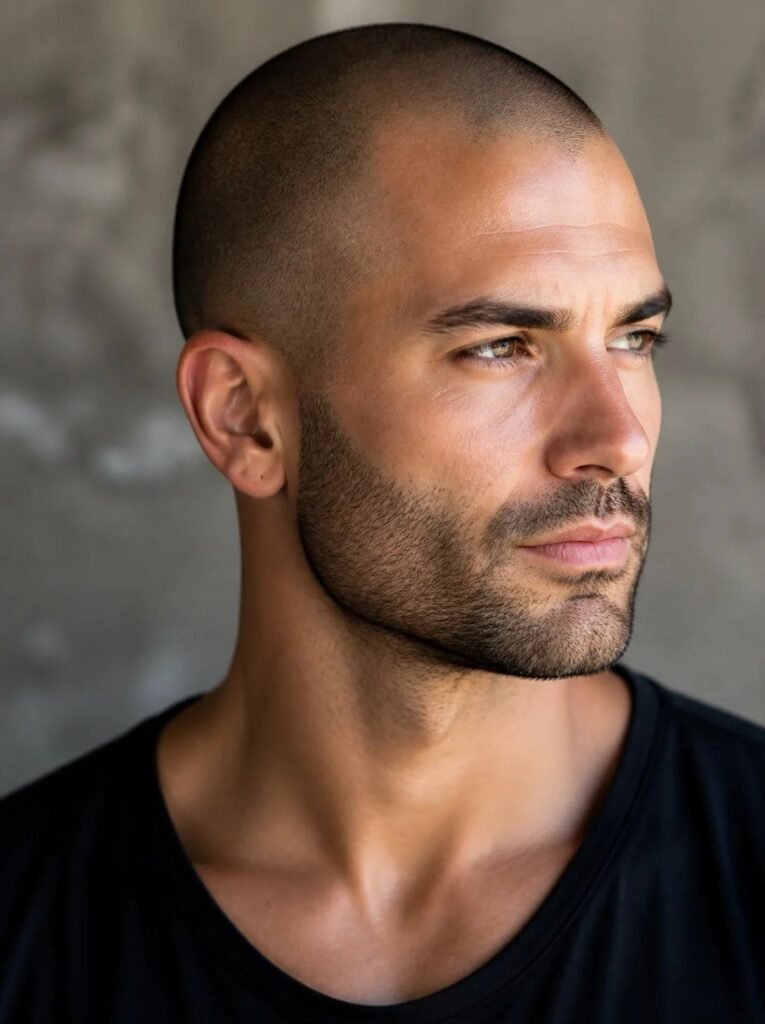
Stubble length on a shaved head is measured in millimetres, and the difference between 1 mm and 5 mm is bigger than it sounds. Use this table as your starting point.
| Length | How it looks | Best for | Upkeep |
| 0.5 to 1 mm | Light shadow, close to a five o’clock shadow | Dense, dark growth; a minimal look | Trim every 1 to 2 days |
| 2 mm | Short, neat, clearly intentional | Most first timers; patchy or uneven growth | Trim every 2 to 3 days |
| 3 to 4 mm | Balanced, visible, full stubble | Round faces, thin frames, lighter hair | Trim every 2 to 3 days |
| 5 mm | Heavy stubble, close to a short beard | Strong growth; men who want more weight | Trim every 3 to 4 days |
Best all round pick: 3 mm. It is visible in daily light, hides small gaps better than very short stubble, and rarely looks overgrown.
How to choose within the range
Your hair colour, density, and skin tone shift the result at any given length.
- Dark, dense hair: go shorter. A 4 mm length can look like a full beard on a dark, thick growth.
- Light, red, or gray hair: go slightly longer. Short stubble in light colours can disappear, especially in photos.
- Patchy growth: stay at 2 mm or shorter. Shorter hair hides gaps and makes the pattern look even.
- Curly or coarse hair: avoid very close cuts, because hair cut below the skin line can curl back in and cause bumps.
Set the length the smart way
Stubble rarely grows evenly, so start longer than your target and work down.
- Let your face grow for three to five days.
- Set your trimmer one setting above your goal.
- Trim against the direction of growth for an even result.
- Step down one setting at a time until you reach your length.
Guard numbers differ between brands, so use the millimetre marking on your trimmer instead of assuming a “number 2” matches yours.
Grooming tips that make stubble look intentional
Stubble looks effortless only when it is maintained. Good stubble has three qualities: even length, tidy borders, and healthy skin underneath. The next four habits cover all three.
Pick one guard and hold it steady
Choose one length and use it across your whole face. Switching between guards creates patches of light and dark that look like uneven growth, and a bare scalp makes that obvious.
- Use a trimmer with fine length steps, ideally in 0.5 mm increments.
- Trim in several light passes rather than one aggressive pass.
- Make small, slow movements around the chin and upper lip, where growth is usually denser.
- Write down your setting (for example, “3 mm, all over”) so you can repeat it next week.
Clean the neckline early
On a shaved head, the neckline gets noticed first. If the neck grows darker and longer than the cheeks, the stubble stops looking like a style and starts looking neglected.
A simple rule works well: imagine a line from just above the Adam’s apple to a point behind each ear. Remove stray growth below that line, and leave the stubble above it.
Be gentle here, because the neck is the area most prone to razor bumps. Some practical protection:
- Shave at the end of a warm shower, when hairs are soft.
- Shave with the grain, not against it, to lower the chance of ingrown hairs.
- Leave a tiny amount of stubble (around 0.5 to 1 mm) rather than a blade close shave.
- Apply an alcohol free balm afterwards.
- Do not pick or squeeze bumps. If they keep returning, a dermatologist can help.
The American Academy of Dermatology also suggests gently brushing the area in one direction and using a warm compress to soften the hairs. These small steps help many men with curly or coarse growth.
Keep the cheek line tidy, not overdrawn
Aim for a natural line that follows your cheekbone. Many men overdo this and carve a hard, geometric edge, which looks styled in the wrong way.
- Clean up only the obvious stray hairs high on the cheeks.
- Keep the line soft and slightly curved, not ruled with a straight edge.
- Leave the sideburn area consistent with the rest of the stubble.
- If you shape the cheek line, shape both sides, then step back and check symmetry in natural light.
A sharp line works with a short beard. With true stubble, a light touch looks better.
Match scalp cadence to beard cadence
This is the habit most guides skip. If you shave your head daily but trim your face once a week, one half always looks fresher than the other. Put both on the same rhythm.
A simple weekly routine:
- Every 2 to 3 days: trim the face to your chosen length and refresh the neckline.
- Same day: shave or clip the scalp so both areas look current.
- After each session: rinse with cool water and apply a light, alcohol free moisturiser.
- Once or twice a week: exfoliate gently, but skip it if your skin is irritated.
Protect your scalp. A bare head is more exposed to the sun. Harvard Health advises sunscreen on the whole head, neck, and ears, reapplied every two hours outdoors. It also notes that shaving can reveal moles or spots, so get anything new checked by a dermatologist.
How face shape changes the best version of stubble
Your face shape decides where stubble helps most. Use a mirror and look at the widest part of your face, then your jaw.
| Face shape | Best stubble move | Watch for |
| Round | 3 to 5 mm with a clear neckline for lower face definition | Very light stubble that disappears |
| Oval | Almost any length; 2 to 3 mm is a safe default | Overthinking it |
| Square | 2 to 3 mm with soft cheek cleanup | Heavy density that makes the jaw look blocky |
| Oblong | 3 to 4 mm, kept shorter under the jaw | Length at the chin that stretches the face |
| Heart | 3 to 4 mm, with a little extra at the chin | Sparse stubble that leaves the chin looking thin |
| Diamond | 2 to 3 mm, even across the cheeks | Heavy cheek growth that widens the middle |
Think of stubble as adjustable shading. On a round face, you want it to carve out a firmer jaw. On a square face, you want it to soften an already strong one.
Shaved head with stubble and glasses

Glasses matter more on a shaved head because there is no hair to frame the face. They become the main feature around your eyes, and your stubble supports them from below.
Here is how to make the three parts work together:
- Skip frames that vanish. Very thin wire or rimless frames can disappear on a bare scalp. A medium weight frame gives your face an anchor.
- Match weight to stubble. Thin frames pair well with 3 to 4 mm stubble. Thick, dark frames work better with 2 to 3 mm, so the face does not feel heavy.
- Use shape to balance. Round faces suit angular frames such as rectangles. Square faces look softer in round or oval frames. Oval faces can wear almost anything.
- Think about shine. If your scalp is polished and glossy, matte frames can add contrast. If your scalp is matte, a touch of metal or gloss adds interest.
- Check the fit. Frames that are too small look out of proportion on a bald head. Frames that are too large dominate a smaller face.
If you wear sunglasses, aviators, wayfarers, and rounded acetate styles tend to work well. Aim for a width that stays proportionate to your face.
When stubble is better than no beard or a fuller beard
A shaved head with stubble is not always the right answer. Here is how it compares to the alternatives.
Stubble versus a clean shave
- Choose stubble if your face looks flat or a little round with a bare scalp, or if you want some jaw definition.
- Choose a clean shave if your growth is very patchy, if it grows in unevenly gray, or if you prefer a minimal, polished look.
- If you are unsure, do not stay in the middle. Either keep stubble sharp or go fully clean shaven, because a half committed look reads as unfinished.
Stubble versus a fuller beard
- Choose stubble for lower upkeep, an easy reset, and a casual or professional look.
- Choose a short or full beard if you want more weight on the chin, a longer face to look shorter, or a stronger statement.
- A fuller beard adds shape but also more work, and it can overpower a smaller face.
Special cases
- Gray stubble: it can look distinguished, but needs a slightly longer length (3 to 4 mm) to register. Keep the edges clean so it reads as deliberate.
- Patchy stubble: stay short (2 mm), keep the neckline crisp, and consider a lightly shaped goatee style if the chin is your strongest area.
- Sensitive skin: a trimmer with a guard is gentler than a blade. Leaving a little length cuts down on bumps and redness.
Final answer: keep it short, clean, and tested on your actual face
The best shaved head with stubble is not extreme. It is a steady length of 2 to 4 mm, a clean neckline, a tidy cheek line, and a scalp and face that are groomed on the same schedule.
Before you commit, run this simple test:
- Grow it out for three to five days so you can see your real growth pattern.
- Start at 4 mm and check it in natural window light.
- Step down to 3 mm, then 2 mm, taking a photo at each stage.
- Add your glasses and look again from a conversational distance, about an arm or two away.
- Pick the length you would be happy to repeat every week, not the one that looks best once.
A shaved head with stubble that is short, even, and consistent usually wins. If your photos tell you it is not working, you can always go clean shaven and try again in a month.
Frequently Asked Questions
Does a shaved head with stubble usually look good?
Yes, for most men. Even, short stubble adds jaw definition and balances a bare scalp, as long as the neckline is clean.
What stubble length works best with a shaved head?
A range of 2 to 4 mm is the safest. Use 3 mm as a starting point, then adjust for your face shape and hair colour.
How do I stop shaved head stubble from looking messy?
Use one guard length, clean the neckline, and trim every 2 to 3 days. Keep your scalp on the same schedule as your face.
Is stubble better than no beard with a shaved head?
It often is, because it adds structure to the lower face. A clean shave works better if your growth is very patchy.
How can I test shaved head with stubble before trimming my beard?
Grow your face out for a few days, then trim in steps from 4 mm down to 2 mm. Take a photo at each stage in natural light, with your glasses on if you wear them.

Noah is a passionate fashion writer who enjoys exploring the latest fashion trends, outfit ideas, styling tips, hairstyles, and seasonal looks. With a strong interest in modern style, Noah creates simple and helpful content to inspire readers and make fashion easier to explore. His goal is to share fresh ideas that help everyone feel confident in their personal style.
